Monday, August 5, 2019

Bucket List Biggie – Birding in Amsterdam


Sedge Warbler, one of many birds I saw in The Netherlands
When I was in Hawaii earlier this year, a couple I met on my nature tour mentioned that they were going to be going birdwatching in Amsterdam later this year with a young man who had set (and still holds) the world’s record for the number of birds seen during a Big Year*.

In 2016, 32-year-old Arjan Dwarshuis recorded 6,852 birds in 40 countries! My life list at the time was around 500, so that was mind-boggling.

When I decided to make Amsterdam our jumping off point for Svalbard, I knew I would try to find some new birds. But, I decided to try a guided session rather than doing it on my own. I also knew I didn’t have much time, but since Scott likes to rest after a long flight, it made sense to set something up for the first afternoon we were there.

This was before we had to change our schedule to accommodate a flight schedule change. If I had known our time was going to be so short, I might not have set up a full afternoon solo activity. But, it worked out because Scott slept the whole time I was gone.

Arjan Dwarshuis from his website
So, I started Googling, found Arjan and contacted him. He directed me to Birding Netherlands, which handled the booking for him. 

Everything seems fine online now, but while I was trying to communicate with Birding Netherlands and Arjan, I had trouble getting Dutch websites to translate into English. 

So, it took a few back-and-forth messages to set up an afternoon session. 

I still think we weren’t quite in sync because Arjan seemed surprised that I was solo rather than a group (and frankly, it was very pricey for a solo participant!). 

It may have been a glitch between Birding Netherlands and Arjan rather than my issue. Not a big deal. 

But, we got it all worked out with an agreement that Arjan would pick me up at the hotel after I arrived. Our flight got in at 8:00 a.m. and, of course, it took awhile to get through customs and to get to the hotel. Arjan seemed anxious to get started, so I rushed and met up with him as quickly as I could change clothes and get all my cameras set up. 

In retrospect, I should have done a few things: like eat something and get some bottled water.

Arjan, who is absolutely delightful, took me to Groene Jonker Natuurmonumenten (Jonker Green Natural Monument), a marshy natural preserve area on the outskirts for Amsterdam. Set in the midst of farms and suburbs, it was an area with ponds and tall grass (murder for trying to photograph birds!) with a couple of miles of paths and no appreciable shade.

Groene Jonker Natuurmonumenten
But, before I talk about Groene Jonker, I must mention that we made a few stops along the way to observe a few birds (most just on the edge of the distance my lens can handle). This involved, once, pulling off a rather busy street. The nature in The Netherlands is pretty close to civilization!

The first birds we saw included some Mediterranean Gulls, which, according to Arjan,were a bit unusual for this area ...

Mediterranean Gulls have pure white wings
A group of Eurasian Spoonbills …

Eurasian Spoonbills
A couple of Eurasian Oystercatchers, which I then saw later at the Natuurmonumenten and still couldn’t get a decent picture ...

A very fuzzy-looking Eurasian Oystercatcher
Fortunately, later in Norway, I saw – and photographed – dozens of them …

A much sharper Eurasian Oystercatcher from Norway
We also saw some White Storks, which I did not manage to photograph (but, I have many pictures from earlier visits to Spain and Germany) ...

White Stork in Segovia, Spain
Then, we continued on, stopping at a canal to photograph a Black Swan …

Black Swan
A juvenile and an adult Great-crested Grebe (really cool-looking birds) …

Great-crested Grebes
And, a family of Mute Swans …

Mute Swans
Then, we arrived at our destination: Groene Jonker or Groene Jonker Natuurmonumenten.

Our welcoming party
I am confused by the name, which is alternately listed as Groene Jonker or Groene Jonker Natuurmonumenten, but is said to be managed by a group called Natuurmonumenten. The group is a large private organization "for conservation and protection of natural areas, valuable landscapes and cultural heritage sites in The Netherlands." 

When we started on the path, we were immediately greeted by a Eurasian Tree Sparrow, posing on the sign and generally showing off …

Eurasian Tree Sparrow
And, almost immediately, a Ring-necked Pheasant (not native, but fairly common), jumped out of the bushes and scurried away …

Ring-necked Pheasant
As I mentioned, it was hot and Groene Jonker had no shade. I was jet-lagged, probably dehydrated and a bit hungry. As much as I enjoyed the birding (and the banana and cookies Arjan brought), I was torn with wanting to see the birds and wanting to get out of the sun and close my eyes. 

I think my compromised condition made me much slower with recognizing the birds and, even more so, photographing the birds. It was pretty frustrating exercise. And, while I added many new birds to my list, I wasn’t happy with most of my photos ….

It didn’t help that many of them were very far away ... 

A distant Common Shelduck
... and that the marsh birds were flitting rapidly in and out of the tall marsh grass ...

A Grasshopper Warbler in the tricky marsh grass
This is especially true of the Bluethroat, a bird I really wanted to photograph. I saw one – several times – always flying rapidly away. No pics.

Of course, some were close and willing to pose ...

Mute Swan
We observed birds in two areas – the distant pond and the grasses along the path.

In the pond and along the shore, we saw a male Tufted Duck …

Tufted Duck
Pied Avocets …

Pied Avocet
Northern Lapwings, adult …

Adult Northern Lapwing
… and juvenile …

Juvenile Northern Lapwing
A parade of Graylag Geese (a mom with her brood) …

Mama Graylag Geese and her five Goslings (plus a Common Redshank on the shore)
Common Shelducks …

A family of Common Shelducks
Common Redshanks  (you can see just a glimpse of the bright red legs that give the bird its name)... 

A feeding Common Redshank
And a Common Moorhen ...

Common Moorhen
There were a number of other birds that were just too, too far away to successfully photograph, including two new birds for me, Black-tailed Godwits (a wading bird) and Common Pochards (a duck).

In the grasses, we saw quite a few Reed Buntings, which were by far the most cooperative – and attractive – of the birds we saw …

Reed Buntings
Other birds included a singing Greater Whitethroat …

Greater Whitethroat
A soaring Marsh Harrier …

Marsh Harrier
A (somewhat rare) Grasshopper Warbler ...

The Grasshopper warbler actually sound like a grasshopper
A hovering Eurasian Kestrel …

The Eurasian Kestrel is larger and less colorful than the American Kestrel
Black-headed Gulls, which resemble the Mediterranean Gulls we saw earlier, except that they have black on their wing tips while the Mediterraneans’ wings are pure white …

Black-headed Gulls
Sedge Warblers …

Sedge Warbler (in the sedge!)
Eurasian Curlews (flying rapidly away) …

Eurasian Curlews (see my photography challenge?)
Plus some Graylag Geese flying by …

Graylag Geese
Once again I saw a few more new birds, in addition to the Bluethroat, that I simply could not get a pictures of. That included Common House-Martins and Common Swifts that were just too fast for me, Gray and White Wagtails and some Common Wood-Pigeons and Stock Doves. I did get a Common Wood-Pigeon the next day in Amsterdam ...

Common Wood-Pigeon in Amsterdam
I also managed to snag some pictures of a Painted Lady Butterfly ...

Painted Lady
And some Common Carder Bees …

Common Carder Bee on a thistle
By this time, I had had enough, I was dangerously on the edge of passing out from exhaustion and thirst. I think Arjan caught on. We had a quick snack and headed back, stopping briefly to observe some very distant Birds … a Eurasian Linnet, a European Goldfinch and a, somewhat rare, Icterine Warbler.

All in all, the birds I have outlined here along with a number of birds we observed that I had also seen elsewhere, such as Canada Geese, Mallards, Northern Shovelers, Gadwalls, Eurasian Collared Doves and Eurasian Magpies, I saw a whooping 53 different species during my walk with Arjan. He saw a few more and we heard a few we didn't see, as well; I only count them if I actually got a good enough look to be sure I saw it. Not bad for one afternoon.

I got many good Reed Bunting shots
I have pondered the birdwatching a bit. As I said, I was generally disappointed in my photos. I just can’t decide if it is my skill, my camera equipment or my expectations. 

Every time I feel that I should just give it all up, however, I get a good shot. On this trip, it was primarily the Reed Buntings that I was able to capture. So, I guess, I will just keep doing it.

By the way, birding in Amsterdam wasn't the "bucket list biggie" noted in the title of this post. Traveling to Svalbard was. But, it was still a treat. 

I will get to Svalbard next.

*A Big Year is a personal challenge or an informal competition among birders who attempt to identify as many species as possible by sight or sound within a single calendar year and within a specific geographic area. Popularized in North America, Big Years are commonly done within single U.S. states and Canadian provinces, as well as within larger areas up to and including the entire world. The American Birding Association Area Big Year record of 836 species was set by John Weigel of Australia in 2016. As I said, the world Big Year record of 6,852 species was set in 2016 by Arjan Dwarshuis. Big Years were popularized by the 2011 movies of the same name starring jack Black, Steve Martin and Owen Wilson.


And, if you are wondering, the big ones get sponsors. One of Arjan's is Canon, which has a large manufacturing presence in Amsterdam.


Trip date: June 15-July 4, 2019

Sunday, August 4, 2019

Bucket List Biggie – Amsterdam

Amsterdam Canal
Every year ya gotta do something special. Last year, I checked two very-hard-to visit National Parks off my bucket list; Kobuk Valley and Gates of the Arctic.

This year, I booked a trip to Svalbard to see Polar Bears and (I hoped) many more arctic birds and animals. But, I had to get to Svalbard …

Amsterdam
When planning our trip to Svalbard, I looked for an affordable direct flight from Colorado to a place in Europe where I hadn’t been and from which I could then fly to Longyearbyen, Svalbard’s largest city and the launching point for our G Adventures “Realm of the Polar Bear” tour.

Amsterdam views
Amsterdam came up. Cool! I have always wanted to go there.

The flight had an odd schedule: depart Colorado in the afternoon and spend the night in at DFW before leaving the next morning for a direct flight to Amsterdam. 

But, actually, that broke up the flight and gave us a buffer for any plane problems (which are common out of Colorado Springs). Fortunately, we had no problems.

So, we planned a brief visit to the Netherlands on our way to Norway: arriving at 8:00 a.m. on a Monday morning and departing Wednesday evening. Just a quick breeze-through.

We had time for only a quick visit
But, close to our departure, it became even shorter when Scandinavian Airlines (SAS), the airline we were flying within Europe, changed a critical flight connection on the way to Svalbard, which would have put us in the Oslo airport for nine hours! ICK.

So, I rearranged the flights, sacrificing additional Amsterdam time. Now, we departed Tuesday evening, spent the night in Oslo and got to Svalbard earlier.

So, we had to make the best of Amsterdam for the short time we were there.

Amsterdam has many tall brick buildings with ornate gables and trim
When you think of Amsterdam, you think of canals (frozen and skated upon in the winter), narrow gabled houses, tulips, bicycles, windmills, Anne Frank and Van Gogh, Rembrandt and Vermeer. I have always wanted to visit, ideally when tulips are in bloom, which is spring. But, this summer visit would have to do.

Amsterdam canal
Although Amsterdam is the capital of the Netherlands, it is not the seat of the government, which is The Hague. The city has a population of 850,000, but the metro area has almost 2.5 million people. I knew that before I went, but was still expecting a quaint European village. 

It’s not. It’s a big city.

We aren’t really city people, although we do enjoy the occasional European marvel. I found Amsterdam nice, but not at the level of marvelousness as, say, Prague or Paris. Of course, we had a very short stay, so I may be selling it short. Plus, it was fairly hot. Fortunately, not as hot as the heat wave that gripped Much of Europe a few days later.

It is a port city that sits on the inside of a peninsula that protects it from the North Sea. Famously below sea level, it holds back the ocean with levees and dikes. We took a boat trip the first night we were there, but I didn’t really perceive the presence of large dikes – just lots of canals, many lined with houseboats.

An upscale houseboat parked on the canal
I have heard that these floating apartments are extremely expensive, I am sure some are nice, but many look decrepit and very, very damp.

Mmmm ... doesn't look too comfy
Although the water in the canals looks a little iffy, our tour boat operator attributed the color to the mud bottom, not to pollution. He said that, for a city, the water is relatively clean. And, even with the heat, it wasn’t smelly.

A Coot Chick navigates the canals
The city's origins are as a small fishing village in the late 12th century near a dam on the river Amstel called, understandably, Amstelredamme. Over time, that name was shorted to Amsterdam. In the 17th century, Amsterdam became one of the most important ports in the world. It is still the commercial capital of the Netherlands and one of the top financial and cultural centers of Europe.

History
Amsterdam was granted city rights in around 1300 and from then on it has flourished. In 1578, the largely Roman Catholic city joined the revolt against Spanish rule and all churches were converted to Protestant. The protest resulted in the Eighty Years' War, which ultimately led to Dutch independence. The Dutch Republic soon became known for its relative religious tolerance. Jews from Spain and Portugal, Huguenots from France, merchants and printers from Belgium and economic and religious refugees from across Europe found safety in Amsterdam. The influx of Flemish printers and the city's intellectual tolerance made Amsterdam a center for the European free press.

Amsterdam
The 17th century is considered Amsterdam's “Golden Age,” during which it became the wealthiest city in the western world. Ships sailed from Amsterdam to the Baltic Sea, North America and Africa, as well as present-day Indonesia, India, Sri Lanka and Brazil, forming the basis of a worldwide trading network. Amsterdam's merchants had the largest share in both the Dutch West India Company  and the Dutch East India Company (in 1602, the Dutch East India Company became the world's first stock exchange by trading in its own shares). Both companies acquired overseas possessions that later became Dutch colonies.

A replica of a typical Dutch sailing ship
Trade played an important role in building the city you see today. Many building, now used for offices and apartments, were originally warehouses. Some are still adorned with ornate wrought iron winches used to haul merchandise through upper story portals.

A winch from one of Amsterdam's early warehouses
Since trades were important, may buildings also sport cornerstones, carved stone placards set within the brick or stone walls, that depict the profession of the occupant.

Cornerstones
Wars with England and France took their toll and Amsterdam's prosperity declined during the 18th and early 19th centuries. During the Napoleonic Wars, Amsterdam's significance reached its lowest point when Holland was absorbed into the French Empire.

After the Netherlands regained independence in 1815, Amsterdam regained some of its panache. New museums, a railway station and the Concertgebouw were built; the Amsterdam-Rhine Canal gave the city Amsterdam a direct connection to the Rhine and the North Sea Canal gave the port a shorter connection to the North Sea.

The Concertgebouw (concert house)
Nazi Germany invaded and took control of the Netherlands in 1940. More than 100,000 Dutch Jews, of whom some 60,000 lived in Amsterdam, were deported to concentration camps. Some Amsterdam citizens sheltered Jews, thereby exposing themselves and their families to a high risk of being imprisoned or sent to the camps, as well. The most famous deportee was Anne Frank, who died in the Bergen-Belsen concentration camp.

Amsterdam alley
During WWII, communication with the rest of the country broke down and food and fuel became scarce. Many left the city to forage in the countryside. To stay alive, people ate dogs, cats, raw sugar beets and tulip bulbs. They scavenged all the wood the apartments of deported Jews and cut down most of the trees in Amsterdam for fuel.

After the war, new suburbs grew, new commercial buildings were erected, the metro was expanded and demolition began on the former Jewish neighborhoods to make room for expansion. 

At the peak of demolition, the Nieuwmarktrellen (Nieuwmarkt Riots) broke out in protest and the demolition was stopped. The entire city center is now a protected area. Many buildings have become monuments and the three concentric canals of the Grachtengordel were added to the UNESCO World Heritage List.

Amsterdam has now become a major tourist attraction, causing real estate prices to surge, pushing out local shops in favor of tourist-oriented ones and making the City Center unaffordable for the most of the city's inhabitants.

The first mass immigration in the 20th century was people from Indonesia, who came to Amsterdam after the independence of the Dutch East Indies in the 1940s and 1950s. In the 1960s, workers from Turkey, Morocco, Italy and Spain emigrated to Amsterdam. After the independence of Suriname in 1975, a large wave of Surinamese settled in the city. Other immigrants, including refugees, asylum seekers and illegal immigrants, came from Europe, America, Asia and Africa. In the 1970s and 1980s, many 'old' Amsterdammers moved to 'new' cities like Almere and Purmerend. 

Amsterdam is a diverse city, but its architecture doesn't really reflect it
Today, people of non-Western origin make up approximately one-third of the population of Amsterdam, and more than 50 percent of the city' s children. Ethnic Dutch (as defined by the Dutch census) now make up a minority of the total population, although by far the largest one. With 180 different nationalities, Amsterdam is home to one of the widest varieties of nationalities of any city in the world.

The City
Amsterdam is located in the Western Netherlands, in the province of North Holland. The river Amstel ends in the city center and connects to a large number of canals, most of which are navigable by boat. Amsterdam is about 6.6 feet below sea level.

NEMO Science Museum, Amsterdam
In the Middle Ages, Amsterdam was surrounded by a moat, called the Singel, which now forms the innermost ring in the city and makes the city center a horseshoe shape. The city has about 90 islands linked by more than 1,200 bridges.

One of the city's 1,200 bridges
In the early 17th century, when immigration was at a peak, Amsterdam developed a comprehensive city plan based on four concentric half-circles of canals with their ends emerging at the IJ bay (IJ’s name is from an obsolete Dutch word meaning "water"). The canals served for defense, water management and transport.

The canals define the city
Known as the Grachtengordel, three of the canals were mostly for residential development: Herengracht ("Canal of the Lords"), Keizersgracht (“Emperor's Canal”) and Prinsengracht (“Prince's Canal”). The fourth and outermost canal is the Singelgracht, which is actually a collective name for all canals in the outer ring. 

Lots of ornate architecture
Amsterdam has a rich architectural history. 

Almost all of the early wood buildings were razed and replaced by brick buildings in the 16th century. 

During this period, many buildings were constructed in the architectural style of the Renaissance with stepped gable façades. 

In the 17th century, baroque architecture became very popular, as it was elsewhere in Europe. Throughout the 18th century, Amsterdam was heavily influenced by French culture, replacing baroque style with different neo-styles, including neo-gothic. 

At the end of the 19th century, when Amsterdam was expanding, the Jugendstil or Art Nouveau style became popular. The last style that was popular in Amsterdam before the modern era was Art Deco, of which Amsterdam had its own version, called the Amsterdamse School. A notable feature of the façades of buildings designed in Amsterdamse School is that they are highly decorated and ornate, with oddly shaped windows and doors.

Amsterdam facades
Amsterdam has many parks, open spaces and squares throughout the city. The Vondelpark, the largest park in the city has an open-air theatre, a playground and restaurants.

De Wallen, Amsterdam's red-light district, offers legal prostitution and coffee shops that sell cannabis. One of Amsterdam’s main tourist attractions, it consists of a network of roads and alleys containing several hundred small, one-room apartments rented by sex workers who offer their services from behind a window or glass door, typically illuminated with red lights. We didn’t visit.

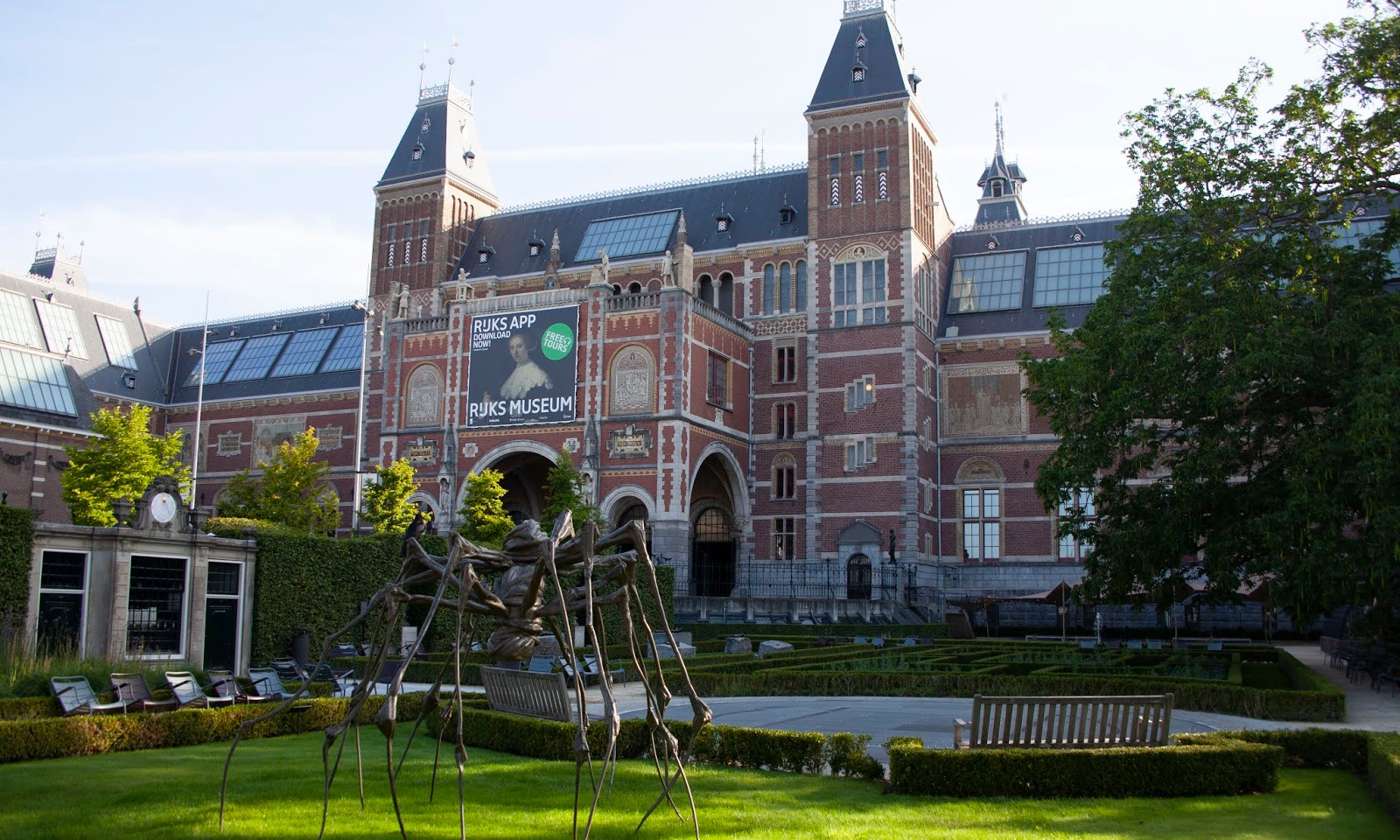
The Rijksmuseum
The Rijksmuseum is the Dutch national museum. It houses the largest and most important collection of classical Dutch art including many works by Rembrandt, and the Van Gogh Museum, which, obviously, house works by Van Gogh as well as mainly works from artists who were his contemporaries and inspirations. 

We visited both. 

The Rijksmuseum was not terribly crowded and allowed non-flash photography (a surprise to me). 

I truly enjoyed its eclectic mix of paintings (including a Van Gogh!), sculpture, household arts ...

Part of the Rijksmuseum collection
... and nautical artifacts, including some pretty impressive model ships ...

Nautical artifacts
Founded in 1798 and moved to Amsterdam in 1808, the Rijksmuseum is now housed in a building that looks like a palace but was actually designed to be the museum. The Pierre Cuypers-designed museum building opened in 1885 and was extensively renovated between 2003-2013. 

The courtyard is now enclosed in a modern structure
A renovation of the south wing of the museum, also known as the 'fragment building' because it was constructed of materials from older buildings, was completed in 1996.

Fragment Building, Rijksmuseum
On both the inside and the outside, the building is decorated with references to Dutch art history. 

A mosaic on the external wall
The Rijksmuseum has 8,000 objects of art and history, from a total collection of 1 million objects from the years 1200-2000. The collection contains more than 2,000 paintings from the Dutch Golden Age by notable painters such as Jacob van Ruisdael, Frans Hals, Johannes Vermeer, Jan Steen, Rembrandt and Rembrandt's pupils.

Rijksmuseum Garden
The Rijksmuseum Research Library is part of the Rijksmuseum, and is the best and the largest public art history research library in The Netherlands.

As I said, we also visited the Van Gogh Museum. 

A Van Gogh at the Rijksmuseum
It was extremely crowded and requires reservations for entry time. It was so packed, it was not a particularly pleasant experience. 

Unlike the Rijksmuseum, the Van Gogh Museum forbids any photography. Even with the no photos rule, I saw lots of people using cell phones to take pictures (thus even making it harder to see the paintings). I also witnessed the guards calling out a few cell phone clickers.

I took a quick walk-through, but didn't get a lot of value because of the crowds. It would be much better to go off season.

Garage in the background
Amsterdam is famous for being one of the most bicycle-friendly cities in the world, although I saw many more parked bicycles than bikes being ridden. Its 881,000 bicycles outnumber  citizens by 30,000+. 

Most I saw were the old-fashioned, sit-upright style rather than racing bikes. 

Most have baskets, boxes or other clever ways to carry groceries, packages, books or babies.

To accommodate all these bikes, Amsterdam has good facilities for cyclists such as bike paths and bike racks ...

Racks and a garage
Plus, there are several huge guarded bike storage garages. 

That's a lot of bikes!
Our Visit
The Royal Palace
We stayed at the Muse Hotel, which was fairly convenient to the museums and the outer city. With our limited time and the oppressive mid-day heat, we didn’t spend a lot of time walking the city, although I got a fairly good look in a solo stroll (where I got a bit lost).

The hotel was nice and our basement room stayed relatively cool. Unlike a lot of cities, Amsterdam isn’t terribly far from the airport, so cab rides from and back to the airport were pretty quick and not terribly expensive (in terms of Europe!).

We didn’t sample a lot of traditional Dutch food (no thanks on the cured herring!), but we had some delicious fish and chips. 

The pastries look yummy!
Jackdaw waiting for a snack
During our museum visits, we had a pizza at a food stall – attended by curious Jackdaws.

Our favorite activity was the boat tour – cooler than walking, with nice narration and a good overview of the city.

We caught the boat just a few blocks from our hotel and it traveled around the outer canal ring to the port and back. It wasn't very crowded.

Me on the boat; Photo: Scott Stevens
Grey Heron by the canal
Of course, no matter where I am, I am always on the lookout for critters, especially birds. 

It can be difficult to find birds in urban settings, but still most cities do have birds, especially green and leafy cities like Amsterdam. And, of course, all the canals add an aquatic aspect to Amsterdam's wildlife profile.

While walking and cruising, I saw a few birds, many repeats of birds I had seen before on other travels. Among my spots, were a couple of Grey Herons, which are similar to our ubiquitous Great Blue Heron and seem to be common all across Europe and Africa.

I also saw some bright-eyed Eurasian Blackbirds ...

Eurasian Blackbird (I had previously seen one at Gottweig Abbey in Austria)
... Eurasian Coots ...

Eurasian Coot (I had previously seen some in Germany)
... including a few chicks ...

Eurasian Coot Chick
... the aforementioned Jackdaw ...

Jackdaw (I had previously seen some in Prague, Czech Republic)
... Egyptian Geese ...

Egyptian Geese (I saw many of these in Africa)
... Mute Swans ...

Mute Swan (I've seen them on multiple continents)
And, there were a few new ones, including the very vocal Dunnock that serenaded us in the Rijksmuseum garden ...

Dunnock
... the Eurasian Blue Tit ...

Eurasian Blue Tit
... the Common Wood-Pigeon ...

Common Wood-Pigeon
... and the very common introduced Rose-ringed Parakeet ...

Rose-ringed Parakeets are everywhere
As we walked about, it struck me what a delightful language Dutch is. You can see how closely it is related to English – just with a surfeit of vowels (or is that vooweeles?).

I love Dutch!
Amsterdam windmill
As I said before, we had limited time and didn’t really have a chance to get into the city. I might still like to go back in some spring to see the surrounding countryside and the tulips for which the country is known. 

I would also like to see  a couple of the country's iconic windmills, which keep the ocean from encroaching on the below-sea-level town. I really missed seeing those.

I did get a small but of exposure to the outskirts on a birdwatching trip the afternoon we arrive, I will talk about that in my next post.


Reed Bunting

Trip date: June 15-July 4, 2019