 |
| A Baltimore Oriole on the Estuary Trail |
I am going to briefly run through others I saw without all the detail I provided on Warblers unless there is something special about the bird.
I saw birds ay multiple places, including …
Vireos
A family of birds that had good representation at BWIAB was the Vireos, a genus of small passerine birds restricted to the New World. Most have dull greenish plumage (hence the name, from Latin virere, to be green), but some are brown or gray on the back and some have bright yellow underparts. They resemble Warblers except for their slightly larger size and heavier bills, which in most species have a very small hook at the tip.
Although most Vireo species are found in Central America and northern South America, nine types occur in the US; I saw six of those at BWIAB:
 |
| Blue-headed Vireo |
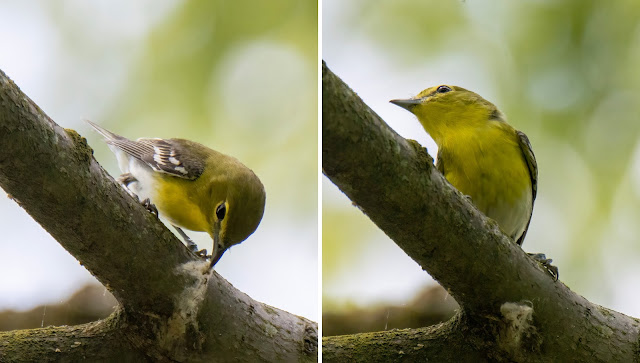 |
| Yellow-throated Vireo |
 |
| Philadelphia Vireo |
 |
| Red-eyed Vireos |
 |
| Warbling Vireo (very common at BWIAB) |
 |
| White-eyed Vireo (this is one of which I previously had no picture) |
Colorful Birds
There was quite a bit of color in that group of Warblers we already saw, but they weren't the only birds with pretty breeding plumage ...
 |
| American Goldfinch |
 |
| Baltimore Oriole |
 |
| Lots of Baltimore Orioles |
 |
| Cedar Waxwing (colorful-ish) |
 |
| Indigo Bunting |
 |
| Orchard Oriole |
 |
| Immature Orchard Oriole |
 |
| Northern Cardinal |
 |
| Rose-breasted Grosbeak |
 |
| Scarlet Tanager |
 |
| Summer Tanager |
,%20Oak%20Openings%20Metropark,%20Toledo,%20Ohio.jpg) |
| Immature Summer Tanager |
Common BirdsThere are always those birds that we see all the time (or at least frequently). And, of course, there were lots of them (one even has "common" in its name) ...
 |
| American Robin |
 |
| Black-capped Chickadees |
 |
| Blue-gray Gnatcatcher and Blue Jay |
 |
| Eastern Meadowlark |
 |
| Brown Thrasher |
 |
| Common Grackles |
 |
| Female Red-winged Blackbird |
 |
| Male Red-winged Blackbird |
 |
| European Starling and Eastern Bluebird |
 |
| Gray Catbird |
 |
| House Finch and Eastern Towhee |
 |
| White-throated Sparrow |
 |
| Savannah, Chipping and Song Sparrows |
 |
| White-crowned Sparrow |
 |
| Northern House Wren |
 |
| Swainson's Thrushes |
 |
| White-breasted Nuthatch |
 |
| This one is not that common, but it didn't fit anywhere else: Ovenbird |
Fast-flying Birds
Everywhere we went were hosts of speedy birds, including Swallows, Swifts and Martins. I never captured a Chimney Swift, but I did get some others ...
 |
| Northern Rough-winged Swallow |
,%20Creek%20Bend%20Farm,%20Sandusky,%20Ohio%20copy.jpg) |
| Purple Martins (male and female) |
 |
| Tree Swallows (male and female) |
 |
| Plus a couple of lovestruck Tree Swallows |
Flycatchers, Woodpeckers and Kingbirds
I saw many Eastern Kingbirds ...
 |
| A good assortment of poses |
... plus lots and lots of Flycatchers ...
 |
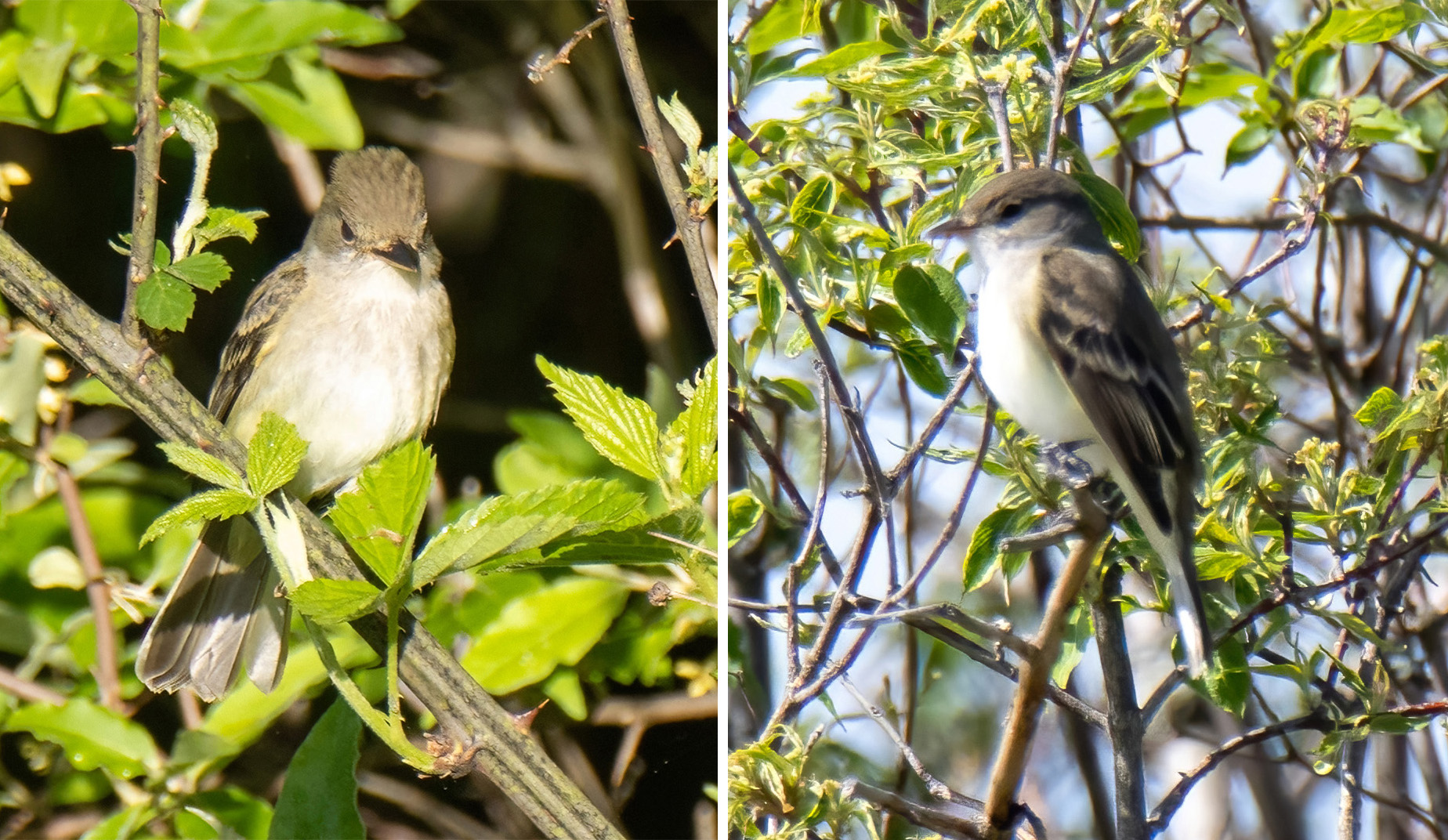
| It is virtually impossible to tell these two apart, by my guides said Alder, left, and Willow |
 |
Great Crested Flycatcher enjoying lunch ...
,%20Sheldon%20Marsh%20State%20Nature%20Preserve,%20Erie%20County,%20Ohio.jpg) | | ... and taking off |
|
 |
| Eastern Wood-Peewee and Eastern Phoebe |
 |
| Yellow-bellied Flycatcher |
And, in the Woodpecker family ...,%20Ringneck%20Ridge%20Wildlife%20Area,%20sandusky,%20Ohio.jpg) |
| Yellow-bellied Woodpecker |
 |
| Red-headed Woodpeckers (there were sooooo many) |
,%20Magee%20Marsh%20Wildlife%20Area,%20Ohio.jpg) |
| Northern Flicker, exciting for me because ... |
 |
| ... it was yellow-shafted instead of red (this one was chased by a Common Grackle) |
Water- and Shorebirds
Bear with me here. The "black swamp" area is wetlands.
 |
| Dunlins feeding in the marsh |
... and wetlands mean water- and shorebirds, of which there were many, some common and some not ...
 |
| I saw hundreds of Canada Geese and only two Pied-billed Grebes |
So what did I see?
 |
| Great Egrets were the most common shorebird (but Snowy Egrets were rare) |
 |
| Another Great Egret |
 |
| One of many Great Blue Herons |
 |
| I saw this nesting Green Heron every day |
 |
| There were Killdeers in multiple habitats |
 |
| Some of the many, many Dunlins |
 |
| Spotted Sandpiper (with spots!) |
 |
| Belted Kingfisher |
 |
| American Coot |
 |
| Common Gallinule |
 |
| A pair of Wood Ducks in the trees |
 |
| Male and female Wood Ducks |
 |
| Male Mallard |
,%20Pipe%20Creek%20Wildlife%20Area,%20Sandusky,%20Ohio.jpg) |
| Hooded Merganser mom and her fuzzy brood |
 |
| Trumpeter Swan with its neck stained by iron, tannin and mud in the water |
 |
| Canada Goose family |
,%20Magee%20Marsh%20Wildlife%20Area,%20Ohio.jpg) |
| Common Tern |
 |
| Ring-billed Gulls |
It may be a wetland, but don't forget to look up ...
 |
| Double-crested Cormorants |
 |
| American White Pelicans |
Raptors and Nightjars
I love Raptors and I felt like I didn't see that many until I started sorting through photos.
 |
| Bald Eagle |
First of all, the marshes have multiple Bald Eagle nests.
 |
| Standing guard over nests |
There were at least two at Magee Marsh, three or four at Ottawa National Wildlife Refuge and a smattering around the other places I visited.
 |
| Nest at Magee Marsh |
The Eagles seemed healthy with multiple large "chicks" in the nests.
 |
| Juvenile Bald Eagle |
Although I didn't see Hawks on a regular basis, when I was at Pipe Creek Wildlife Area we saw at least 20 Hawks (mostly Broad-winged with a few Red-tailed) flying over as they migrated north.
I%20MG_9403%20copy-denoise-standard%20copy.jpg) |
| Many of the migrating Hawks were juveniles |
 |
| One Broad-winged Hawk even landed |
I saw Eastern Screech Owls in three different places, some on multiple occasions.
 |
| Most were napping |
And, a few Raptors were just single appearances ...
 |
| American Kestrel |
 |
| Osprey |
 |
| The Black Vulture, left, was rare for Ohio; Turkey Vultures, right, were common |
One day, I saw a sleeping Common Nighthawk on the Boardwalk ...
 |
| It was there all day |
... and, then, one evening, I saw another napping in the parking lot ...
 |
| In a tree right above my car |
I stayed with the latter until about 8:30 p.m., when it took off to hunt with its buddies ...
 |
I watched the one in the parking lot until it lifted off for its evening hunt
|
Nests
Throughout my travels, I saw many nests ...
 |
| Trumpeter Swan |
 |
| CW: Gray Catbird, Baltimore Oriole, Rose-breasted Grosbeak, two American Robin nests |
... and lots of nest-building ...
 |
| CW: Blue-gray Gnatcatcher, Prothonotary Warbler, Black-capped Chickadee, Eastern Kingbird |
 |
| A Black-capped Chickadee spitting out wood chips it excavated from a log |
 |
| Female Prothonotary Warbler in her nest |
Lifers
I mentioned that I saw 144 species, of which 13 were Lifers. I was able to photograph only 10 of the Lifers. I did not get useable shots of a Chimney Swift, American Woodcock or Mourning Warbler, but I did get five new Warblers that I already covered ...
That's some pretty good variety and lots of birds. I won't subject you to much more. But, I will talk about what else I saw in my next post.
 |
| There's more to see! |
Trip dates: May 3-21, 2025


,%20Sheldon%20Marsh%20Wildlife%20Area,%20Ohio.jpg)


,%20Oak%20Openings%20Metropark,%20Toledo,%20Ohio.jpg)


,%20Creek%20Bend%20Farm,%20Sandusky,%20Ohio%20copy.jpg)



,%20Sheldon%20Marsh%20State%20Nature%20Preserve,%20Erie%20County,%20Ohio.jpg)


,%20Ringneck%20Ridge%20Wildlife%20Area,%20sandusky,%20Ohio.jpg)

,%20Magee%20Marsh%20Wildlife%20Area,%20Ohio.jpg)


,%20Pipe%20Creek%20Wildlife%20Area,%20Sandusky,%20Ohio.jpg)


,%20Magee%20Marsh%20Wildlife%20Area,%20Ohio.jpg)


I%20MG_9403%20copy-denoise-standard%20copy.jpg)


,%20Winous%20Point,%20Ohio.jpg)


