Sunday, May 15, 2022

Birding in Costa Rica #14: Hiking on the Osa Peninsula

A King Vulture soaring overhead
As I mentioned in my last post, we spent quite a bit of time in Osa hiking. 
Well, maybe walking is a better description. Or, maybe slowly walking and standing still a lot to view birds and wildlife. 

We were there to see birds, not to break speed records (whew!)
Whatever ...

During our time there, we took an afternoon hike to the BioStation and then on to the seashore. Earlier, Heather had asked if we could go to the beach to swim and Nito said he wouldn't recommend it because of currents.

A beautiful shore on a beautiful day
When we got to the shore, we saw that it was obviously better suited to viewing than water sports. It was rocky with waves crashing against the volcanic rocks that jutted into the ocean. 


Then, on the day we had no van, we took two hikes, a morning in the nearby jungle and an afternoon where we made our way to old-growth forest and, I think, into Corcovado National Park. That day, we hiked about six miles.

Most of the trails were fairly level, although there was some up-and-down when we went to ocean. 

Osa Vista
The trails were wide and easy to follow, but covered in leaves and lots of roots just trying to grab your feet and throw you to the ground. With all the leaves, I was certain we'd see some snakes, but we didn't. Nito had seen a Fer-de-Lance (one of the world's most poisonous snakes) the first night, so we were on alert.

Part of our hikes was on the road
Plus, we were still concerned about Ants, although Bullet Ants are not as common on Osa as in La Selva.

In addition to my camera, I took a walking stick and that was a good idea.

The vegetation was thick, but obviously immature near the BioStation. That area is regrowth reclaiming old ranches and farms that had deforested parts of the Peninsula. 

The far end of one hike was pristine, old-growth jungle that was, obviously, more stately with lots of huge, gnarly trees.

So, did all this walking in the oppressive heat and humidly yield anything? Oh, yes!

Birds
It seems that one of the most common Osa jungle birds are Woodcreepers, which are endemic to the Neotropics. Related to Ovenbirds, they tend to be rather large, ranging from 5 to 14 inches long . The ones we saw were all shades of brown, with varying streaks, bars or spots, generally on their heads and napes.

A Northern Barred Woodcreeper ... well, creeping
Woodcreepers feed mainly on insects taken from tree trunks. They have long, stiff tails that actually support most of their body weight; a bird that loses its tail usually has difficulty climbing. Woodcreepers climb by flexing their legs and hopping up the trunk. Their front toes are strongly clawed and toe IV is as long as toe III to increase the ability of the bird to grasp around branches.

Here, we saw Black-striped ...

The most social of all the Woodcreepers we saw
... Cocoa, Northern Barred, Tawny-winged, Streak-headed, Plain Xenops and Wedge-billed ...

Cocoa, Northern Barred and Tawny-winged; I didn't get a photo of the last three on Osa
I had captured the Plain Xenops and Streak-headed Woodcreeper earlier on our trip ...

Streaked Woodcreeper at Avaro's and Plain Xenops in Carara National park
A similar sized and colored but unrelated bird was the striking Rufous Piha ... 

A large jungle bird
This bird is actually a Cotinga, which means it is a cousin of the Three-wattled Bellbird.

In the bushes, we saw a nice assortment of small-to-medium-sized birds, including Tanagers, Flycatchers, Greenlets, Woodpeckers and Warblers ...

CW: Chestnut-sided Warbler, Cinnamon Woodpecker, Scarlet-rumped Tanager, Tawny-crowned Greenlet, Great Crested Flycatcher, White-throated Shrike-Tanager, White-Shouldered Tanager, Streaked Flycatcher
And, we saw a lovely female Black-throated Trogon ...

Not as colorful as her mate, but pretty
When we were in the open area of the BioStation (where we could actually see the sky), we saw lots of birds circling so, so high up they could barely be seen with binoculars. This included Gray-breasted Martins, Costa Rican Swifts, White-collared Swifts and Turkey and Black Vultures. 

But, one we did see fairly close was a magnificent King Vulture ...

A bird that we had hoped to see
Photo: Osa Conservation
A very large bird, the King Vulture has a wingspan that can reach 7 feet.

Predominantly white, it has gray to black ruff, flight and tail feathers. The head and neck are bare with red and purple skin on the head, vivid orange on the neck and yellow on the throat. The colors can vary.

The head is wrinkled and folded and there is an irregular golden crest attached on the cere above the orange and black bill.

A scavenger, the King Vulture often displaces smaller Vulture species from a carcass, which may be how it earned its status as "King. " Or the name may be a reference to Mayan legends in which the bird was a king who served as a messenger between humans and the gods.

The King Vulture soars for hours effortlessly, flapping its wings infrequently. While in flight, its wings are held flat with slightly raised tips and, from a distance, it can appear to be headless. 

It is non-migratory and, unlike the Turkey, Lesser Yellow-headed and American Black Vulture, it usually lives alone or in small family groups. One or two birds generally descend to feed at a carcass, although occasionally up to ten or so may gather if there is significant amount of food.

Soaring overhead
Principally a carrion eater, it consumes anything from cattle carcasses to beached fish and dead lizards. 

The King Vulture has no voice box, but it can make low croaking noises and wheezing sounds that it uses in courtship. It snaps its bill loudly when threatened. 

The King Vulture's only natural predators are snakes, which will prey upon the vulture's eggs and young, and large cats such as Jaguars, which may surprise and kill an adult vulture at a carcass.

Although currently listed as Least Concern, they are decreasing in number, due primarily to habitat loss. The one we saw had a transmitter on its back (in fact our Osa presenter told us they had just placed the transmitters the day before as part of the Ridge to Reef project).

When I really zoomed in, I saw it
Another great sighting for the BioStation was a gorgeous swallow-tailed Kite ...

Magnificent
I had seen some in Florida a few years ago and missed a shot and then seen another one earlier in the trip and missed again, so getting the photo was extra sweet.

On our hikes, we didn't see many raptors other than Vultures and the Kite, except one Common Black Hawk perched in a palm tree on the beach ...

Just surveying his domain
Every jungle hike involves searching for tiny little (and usually colorful and entertaining) Manakins. Osa delivered with a female Blued-crowned Manakin ...

Male Manakins go through elaborate courtships to attract these cute females
... and a male Orange-collared Manakin ...

Such a poser!
We even got video of the latter ... 


Army Ants and What They Bring
I mentioned earlier that our guide, Nito, was enamored of Army Ants. Indeed, these interesting creatures were his pathway to his profession.

Army Ants at work
As we were hiking through the jungle and, no matter how hard we tried not to, making considerable noise walking through the deep leaf cover, Nito suddenly stopped and said, "I hear Army Ants approaching." Of course, I heard nothing. But, we waited, and eventually, we started to see advance columns of Ants, a wide variety terrified bugs (Roaches, Crickets, Flies) leaping from the jungle floor to escape the Ants.

Working cooperatively
The name Army Ant is actually applied to more than 200 Ant species in different lineages in the world and Costa Rica has 600 different species of Ants in general; I do not know what type these were.

But, the main characteristic of Army Ants is that they constantly undertake raids in the jungle, killing and taking home insects and small animals. Their main prey are the nests of other ants whose eggs and larvae they steal to feed on their own offspring. 

Opportunistic birds take advantage by following the swarm and picking off insects that try to escape.

Nito said birds would come and they did
Almost blind, Army Ants rely on their sense of smell to find and track prey. They don't build nests, instead bivouacking for a night to several weeks in hollow logs or underground.

They carry heavy loads
Because they voraciously devour Scorpions, other Ants and Cockroaches, Costa Ricans call them "limpiadores," which means "cleaners" in English.

These Ants are taking out the garbage
A colony of Army Ants can consume up to 500,000 prey animals each day, including ground-dwelling arthropods and their larvae, earthworms and occasionally also the young of vertebrates, turtle eggs or oily seeds. A majority of the species, the "colony robbers," specialize in the offspring of other Ants and Wasps.


When Army Ants forage, the trails that are formed can be over 66 feet wide and over 330 feet long. They stay on the path through the use of a concentration gradient of pheromones. The concentration of pheromone is highest in the middle of the trail, splitting the trail into two distinct regions: an area with high concentration and two areas with low concentrations of pheromones. The outbound Ants will occupy the outer two lanes and the returning Ants will occupy the central lane.

We watched them move along and then came the reward, the birds that follow (and eat) the ants and the bugs they chase (to eat). This included the adorable little Bicolored Antbird ...

Those eyes stand out
And, some Black-hooded Antshrikes ...

Left, female; Right, male Black-hooded Antshrike
Later, we saw another ant-eater, the Streak-chested Antpitta ...

The cutest bird in Costa Rica
This bird actually looks like the embodiment of a child's drawing of a bird ...


The Army Ants weren't what I expected, because the Ants did not arrive en masse, instead they moved in columns underneath the ground cover. It's amazing that, moving under the leaves like that, they didn't make more noise.

The didn't look as organized as I expected, but I am sure they had a plan
Of course, we saw lots of bugs, most tiny and fleeing for their lives. But, in the course of our hike, we did encounter a beautiful orange Leaf-footed bug ...

It was hard to see in the flower, but then it jumped
... and Butterflies ...

A Postman Butterfly and a Sister Butterfly
... and an assortment of Wasps ... 

There were huge Warrior Wasp nests everywhere
... and whatever these are ...

Bees? Wasps? Termites? I don't know
have been trying to ID the above nest, which blends perfectly with the tree. They look like bees, but there is a Termite tunnel running beside the hive.

Animals
Although we never saw any Jaguars, Tapirs or Anteaters, we did see a few more White-nosed Coatis and Agoutis rustling through the jungle, plus a Collared Peccary that crossed the path right beside us as we were watching the Army Ants ...

You may know this as a Javelina
Plus, we encountered a troop of curious Geoffrey's Spider Monkeys ... 

Monkeys had become common sightings
You will recall, I talked about Spider Monkeys in an earlier post.

Look at that adorable face
Best Bird: Scarlet Macaw
But, our best encounter on our hikes was close and long-lasting. When we reached the beach, we found a gorgeous Scarlet Macaw eating Beach Almonds, an introduced plant that Macaws have adopted as a favorite food. 

One of Costa Rica's most iconic birds
Our presence didn't faze it a bit. It was too busy chowing down.

One hungry bird
This one was alone; most of the Macaws we saw were in pairs (most likely with its life-mate) or in fast-flying groups.

A pair flying over the Lodge
This large red, yellow and blue Parrot is common throughout Costa Rica, despite suffering from habitat destruction and the pet trade.

Close-up detail
An adult Scarlet Macaw is almost 32 inches long.

A very large Parrot
More half is the Macaw's pointed, graduated tail ...

An impressive tail
As impressive as its size is its lifespan. The Scarlet Macaw can live up to 90 years in captivity, although a more typical lifespan is 40 to 50 years.

Showing off its colors
Scarlet Macaws are vocal, making raucous squawks, squeaks and screams designed to carry great distances to call for their groups. 

Captive Macaws are known to be adept mimics of human speech.

They feed on fruits, nuts, seeds, flowers, nectar, insects and larvae, snails and foliage. Macaws also eat clay, although why isn't known. That heavy bill is an incredibly effective nutcracker, as the debris below the feeding sites demonstrates. 

Beach Almond shells
And, they have a scaly tongue that can reach in to grab out the nut meat. There is actually a bone in the tongue that helps with this. 

We really enjoyed getting to know this beautiful bird. See a video here.

Macaws actually sleep about 12 hours a day
Of course, there were more birds, but I promised I wouldn't bore you with "the ones that got away."

Next up: Some driving tours of the Osa Peninsula.


Trip date: March 9-27, 2022

Saturday, May 14, 2022

Birding in Costa Rica #13: Osa Peninsula

A Central American Squirrel Monkey at our Lodge
Off to our final Costa Rican Adventure! We were heading to the Osa Peninsula for three days of birding before heading home. 
 
Osa Peninsula 
Google Maps
The Osa Peninsula is in the Puntarenas Province (same province as Tárcoles, where we went at the beginning of our tour). It juts out of southwest Costa Rica like a thumb with the Pacific Ocean to the west and the Golfo Dulce to the east. It was formed geologically by a fault that extends north into California. 

With under 9,000 inhabitants, Puerto Jiménez, where we would fly in, is the largest town on the Osa Peninsula. 

Because of its remoteness, logging started on Osa only in the 1960s. By 1975, there were plans for a major international logging operation. Researchers petitioned President Daniel Oduber to protect the area, which he did by making it a National Park. For this he received the Albert Schweitzer Award from the Animal Welfare Institute. 

An ancient tree
Already present gold miners were allowed to stay, but by 1986, their number had increased to about 1,000 (not counting their families), who also hunted the wildlife. So, the government evicted them.

There are still some 400 illegal miners who threaten the land by using more destructive modern mining methods. It is estimated that 38 percent of the park has been exploited by gold miners. 

Illegal logging is not frequent, but is problematic because the trees that are removed are scarce and essential to the ecosystem. 

Today the Osa Peninsula is a popular ecotourism destination because of its phenomenal biodiversity; it is home to at least half of all species living in Costa Rica. 

An Orange-chinned Parakeet
Osa shelters Costa Rica's largest remaining population of Jaguars and Tapirs, although seeing either is rare.

Osa from the air
The Peninsula has few roads – and the ones it has are rather rough. In addition to both old-growth and reforested jungle, it has a large number of cattle ranches. It’s at sea level and, as you would expect, it’s beastly hot and humid. Plus, we saw more bugs here than anywhere else.

Our Itinerary
The plan from PIB said that we would be visiting Corcovado National Park during our visit. But, much to our disappointment, we did not. 

We had originally been scheduled to have a different guide than Nito and I think this misstep had something to do with the guide change. When we asked Nito why we weren’t going and pointed out the listing in the itinerary, he was genuinely surprised. The disappointment was compounded by the fact that, on multiple occasions, Nito told us how wonderful the Park is and said, “You really should visit.”

I do understand that one of the typical ways to get there is a very long and very hot hike and I don’t think all our group members were up for that. But apparently, there is also a boat that can take you there. So, the disconnect between the agenda and the tour was a negative.

It would be easier if we could just fly there
But, that doesn’t mean we didn’t have a good visit, because, in general, we did.

Sometimes you have to shoot from the van
Of course, I already mentioned the other issue in an earlier post: unlike our tour with Juan Diego, we did not have a vehicle at our disposal the entire time. 

We had one day with no transportation. The van we had was small with windows that wouldn’t open and doors that had to be opened from the outside, so that made the times we birded on the road difficult. Still, we managed to see a lot.

Here’s what we did while at Osa: 

Day 1: Fly into Puerto Jiménez from San José aboard a small and very cozy plane (as in, you cannot stand up and walking down the “aisle” is a challenge), where we were met by Nito.

Left, the cockpit on our Sansa flight; Right, Susan deplanes in Puerto Jiménez
We birded as we drove down to the bottom of the Peninsula where our Lodge was located. After getting settled and having lunch, we took an afternoon hike (hot, hot, hot) for more birding around the BioStation.

Day 2: We took two hikes: one in the morning that took us to the ocean and one in the afternoon that took us into old-growth forest. It is possible that we actually set foot in the National Park here; I think we did.

A Black-striped Woodcreeper in the old-growth forest
Day 3: We went out in the van for birding along many of the drivable roads on the Peninsula. You could torture me and I probably couldn’t tell you exactly where we went, but we passed farms, went to a beach shrouded in mangroves, birded from a bridge over a river ...

A Great Antshrike near the "birding bridge"
... and spent some time in Puerto Jiménez. I think we did pretty much every place along the Osa Peninsula roads.

Day 4: We birded on the Lodge grounds and then drove to Puerto Jiménez to drop off two of our members who had an earlier flight back to San José. Then, we birded and had lunch in town before getting on our flight back to San José.

The Puerto Jiménez runway (it's a very, very small airport)
I am going to cover what we saw on these adventures in three buckets: Lodge Grounds, Hikes and Road Birding.

Osa Verde BioLodge
Map: Osa Verde BioLodge
Our accommodations were breathtaking. We stayed at the brand-new Osa Verde BioLodge, which was built by Osa Conservation, a nonprofit organization dedicated to protecting the globally significant biodiversity of the Osa Peninsula.

One of Osa Conservation’s research “BioStations” is about a quarter of a mile away. 

Osa Conservation built the Lodge after having multiple requests from ecotourists to stay on the premises. We were the first group of actual tourists to stay there. Before, all the visitors had been scientists and government employees who had business with the research station.

The Lodge Runs on 100 percent renewable energy and all the profits support Osa Conservation’s restoration and conservation efforts.

The Lodge has just a few duplexes strung out along a ridge that looks down to the ocean. The rooms are huge with an equally huge deck that sports nice wooden furniture and a hammock.

My private deck
Each room has two beds, a desk ...

This is just half the room
... and a large bathroom with an indoor and an outdoor shower. The indoor shower is open to the outdoor one, so that takes a little getting used to. But, it was lovely.

I want!
My bathroom had a gorgeous Harpy Eagle mask as decor. Had they had a store, I would have bought one. Other rooms had other decorative masks. From what I saw, the Harpy was the best.

The rooms were not air-conditioned, which bothered some of our group. However, they had two powerful ceiling fans, which made them quite comfy. You just had to be careful not to leave any papers lying around or you'd probably lose them all.

The shelves had real animal skulls
The windows all had industrial-strength screens and the heavy doors to the outside and to the bathroom were the kind that slam if you don’t carefully close them. I assume that was to keep bugs and other critters (Monkeys!) out. 

Still, the rooms had a pretty large and interesting assortment of bugs. At least I didn’t have any scorpions like Michael and Neil did. 

Joyce has a Bat that spent every day in her shower. Apparently, the Bat had been working its way through all the duplexes.

Mexican/Lesser Sac-winged Bat
The Lodge provided a good birding guide and pair of binoculars.

Meals were served at a beautiful long wooden table on a deck overlooking the jungle and beyond to the ocean.

The jungle
The food was inventive and delicious. A big treat (when we were all starving) was fried taro and plantain chips. Paper thin, hot and crispy. Delicious!

Immediately below the deck were plants that attracted Hummingbirds ...

CW: Male Blue-throated Goldentail, two shots of a female Blue-throated Goldentail; Male Charming Hummingbird
... and Butterflies ...

Tiger Longwing Butterfly
At least the Butterflies are easier to photograph ...

Long-tailed Skipper
We also saw some White-necked Jacobin and Long-billed Hermit Hummingbirds on property, but they evaded my camera.

All day long, we could see long lines of Brown Pelicans ...

Usually, they flew north, but sometimes they went the other way
... and groups of Scarlet Macaws flying over ...

Colorful birds in flight
... as well as occasional raptors and parrots. 

A very back-lit Yellow-headed Caracara
We also saw a really cool Common Basilisk just hangin' by the dinner table ...

A beautiful adult male Common Basilisk with his fins-back and crest
The canopy above us was a frequent crossing and resting place for both Central American Squirrel Monkeys …

Adorable
… and White-faced Capuchin Monkeys …

Awesome
... and, the sound of Howler Monkeys was common.

Lodge Grounds
The Lodge had lots of wildlife, so just hanging around was rewarding. I already mentioned the Hummingbirds and Butterflies, but we also saw Blue Dacnises and Scarlet-rumped Caciques …

Left, female and male Blue Dacnis; Right, Scarlet-rumped Cacique
... Red-legged Honeycreepers …

A male and female Red-legged Honeycreeper
... Black-striped Sparrows …

Enjoying early morning sun
... And Yellow-throated Toucans … 

Frequently in the trees above us
Plus, Nito took me to the edge of the property to show me a Common Pauraque he had discovered nestled in the leaves (presumably nesting).

They don't build nests; they just lay eggs on the ground
This weird-looking nightjar has extraordinary camouflage; Nito found it only because he saw its eyes reflecting at night.

Maybe it's just me, but she didn't seem happy to see us
Plus, Nito showed me some Sucker-footed Bats (that's what he called them; I believe they are Spix's Disk-winged Bats) that were sleeping in a rolled-up leaf right outside the door to my room. They are among a very small number of bats that have suction cups rather than claws on their wing tips.

Letting sleeping Bats lie
Unlike the Honduran Tent-making Bats that alter leaves to make a shelter, these little critters just find a naturally furled leaf to offer protection during the day. They next morning, I found them again in a different leaf.

Nito showing Heather and Michael the Bats
But the coolest thing about the Lodge were the Monkeys. 

Squirrel Monkeys
The Central American Squirrel Monkey lives just in the northwestern tip of Panama near the border with Costa Rica and the central and southern Pacific coast of Costa Rica, primarily in Manuel Antonio and Corcovado National Parks.

Watching from the canopy
A small Monkey, adults reach only 10 ½ to 12 ½ inches in length, not including the tail, which adds an additional 14-15 inches. Males are about 16 percent larger than females. Squirrel Monkeys have the largest brains of all primates relative to their body size.

See the loooong tail draped over the branch?
Unlike Costa Rica’s other Monkeys, the Central American Squirrel Monkey does not have a fully prehensile tail, except as a newborn, and the tail is primarily used to help with balance.

Taking a break from feeding
Squirrel Monkeys have an omnivorous diet. They eat mainly fruit, but also consume insects and insect larvae (especially grasshoppers and caterpillars), spiders, nuts, leaves, bark, flowers, nectar and small vertebrates, including bats, birds, lizards and tree frogs. 

It finds its food foraging through the lower and middle levels of the forest, typically between 15 and 30 feet up. Two-thirds to three-quarters of each day is spent foraging for food.

Feeding in the trees
The Squirrel Monkey has a unique method of capturing tent-making bats. It looks for roosting bats by finding their folded-leaf tents, climbing to a higher level and jumping onto the tent from above. If a dislodged bat does not fly away in time, the monkey pounces on it on the ground and eats it. 

The Squirrel Monkey is an important seed disperser and a pollinator of certain flowers, including the passionflower. While it is not a significant agricultural pest, it does sometimes eat corn, coffee, bananas, figs and mangoes.

Perching in the canopy
Predators include raptors, wild cats and snakes. The oldest males bear most of the responsibility for detecting predators. When a Monkey detects a raptor, it gives a high-pitched alarm peep and dives for cover. All other Squirrel Monkeys that hear the alarm call also dive for cover. 

They give alarms for any raptor-like object, including small airplanes and falling branches
Raptors are dangerous to newborn Squirrel Monkeys; only about 50 percent of the babies survive, primarily because of raptor predation.

Squirrel Monkeys live in large groups that typically contain between 20 and 75 monkeys, with more females than males. 

Monkey paw
With one of the most egalitarian social structures of all monkeys, females do not form dominance hierarchies and males do so only at breeding season.

Arboreal and diurnal, the Squirrel Monkey most often moves through the trees using its four legs to travel and its tail for balance.

Although South American species often travel with and feed together with Capuchin Monkeys, the Central American Squirrel Monkey only rarely associates with the White-headed Capuchin. We saw both kinds in the same trees, but not at the same time. 

Certain bird species associate with the Central American Squirrel Monkey, preying on insects and small vertebrates that the Monkeys flush out. This includes Double-toothed Kites, Gray-headed Tanagers and a variety of Woodcreepers, Motmots and Trogons.

His view of a Capuchin
A noisy critter, this Monkey squeals, whistles and chirps. An Infant Squirrel Monkey remains dependent on its mother for about one year, riding on her back as she jumps through the trees.

The Central American Squirrel Monkey population declined precipitously after the 1970s because of deforestation, hunting and the pet trade. It is listed as Endangered.

A family group (with the infant on Mom's back)
Capuchin Monkeys
The White-faced Capuchin Monkey, which lives in in Honduras, Nicaragua, Costa Rica and Panama, is the same Monkey that you’ve seen as an "organ grinder" or in movies and TV shows.

A Capuchin in the trees
When Portuguese explorers reached the Americas in the 15th century, they thought these small Monkeys resembled the friars from Order of Friars Minor Capuchin, an offshoot from the Franciscans, who wear brown robes with large hoods. That’s how they got their name. 

It does look like a monk
They range from 12 to 22 inches long, with a prehensile tail about the same length.

Jumping over the path from my room to the dining deck
Unlike the Spider Monkey, the Capuchin's tail is fully covered with hair and does not have a fingerprint-like friction pad. That's because they use their prehensile tails more for support during foraging than for locomotion. They rarely support their entire body weight with their tails. Uniquely, they use their tails as anchors to freeing their hands to forcibly manipulate and twist food objects. For example, the tail provides leverage while they rip open hives looking for invertebrate prey or plucking palm fruits from wobbly tree branches. 

Flying Monkeys!
Capuchin Monkeys prefer forest environments that give them access to shelter and easy food. The canopy of the trees allows for protection from threats above and their ability to climb trees with ease allows them to escape and hide from predators on the jungle floor. Like Squirrel Monkeys, they benefit their environment by spreading seeds and pollen.

Watching from a palm tree
Like most New World Monkeys, Capuchins are diurnal and arboreal. 
They live in groups of 10 to 40 members, comprising related females, their offspring and several males, led by an alpha male and an alpha female. They mark a central area of their territory with urine and defend it against intruders. 

Infants cling to their mother's chest until they are larger, after which they move to her back. Adult male Capuchins rarely take part in caring for the young.

Obviously, an older infant
Omnivores, they feed on a more varied range of foods than other Monkeys. This includes leaves, flowers, fruit, seeds, pith, woody tissue, sugarcane, nuts, bulbs, arthropods, mollusks, a variety of vertebrates and even primates. Capuchins have been observed to be particularly good at catching frogs. 

Capuchins use stones to crack hard nuts and those living near water will also eat crabs and shellfish by cracking their shells with stones.

He looks pretty smart
The Capuchin is considered to be the most intelligent New World monkey and is often used in laboratories (I already mentioned that they use stones as tools). During the mosquito season, they crush millipedes and rub them on their backs to create a natural insect repellent.

In 2005, experiments were conducted on the ability of Capuchins to use money. After several months of training, the Monkeys began exhibiting behaviors considered to reflect an understanding of the concept of a medium of exchange that were previously believed to be restricted to humans. They showed the same propensity to avoid perceived losses demonstrated by human subjects and investors. 

An intense-looking animal
When presented with a reflection, Capuchin monkeys react in a way that indicates an intermediate state between seeing the mirror as another individual and recognizing the image as self. Most animals react to seeing their reflections as if encountering another individual they do not recognize.

Since they have a high reproductive rate and can easily adapt to their living environment, loss of the forest does not negatively impact the Capuchin Monkey as much as other species, although habitat loss is still a threat.

The Monkeys were wary of us
Natural predators include wild cats, Tayras, snakes, crocodiles and birds of prey.

Ridge to Reef
On two of the nights we were at the Osa Verde BioLodge we had presentations by Osa Conservation. One was on Sea Turtles ...

Collecting Sea Turtle eggs; Photo: Osa Conservation
...and one was on the organization's "Ridge to Reef" program.

Ridge to Reef is a ''whole-of-ecosystem' or integrated management approach to conservation. The goal is to maintain or restore the interconnections between the natural and social systems from the mountain ridges of volcanic islands, through coastal watersheds and habitats and across coastal lagoons to the fringing reef environments, including shoreline, mangroves and underwater habitats. 

This integrated approach to freshwater and coastal area management emphasizes the connections between land, water and coastal systems.

Photo: Osa Conservation
Osa is working to ensure that wildlife can easily migrate all the way from the tops of the mountains to the ocean on the Osa Peninsula.  Fortunately, on the Peninsula there are a number of National Parks that provide protection for wildlife and the environment. Unfortunately, these Parks are not connected. So, wildlife moving up and down in altitude encounter obstacles like roads, ranches, farms and towns.

So, Osa is doing two things: monitoring and tracking wildlife to understand migration habits and deterrents. And, working with local ranchers, farmers and towns to create natural corridors.

Baird's Tapir; Photo: Osa Conservation
For the former, they were launching a Baird's Tapir collaring program while we were there. We really wanted to watch, but after we hinted, no invitation was issued. Since it was in the middle of the night and they had not collared any of these large, potentially dangerous animals, that made sense. Still, it would have been cool. I guess if I really wanted to experience it, I could be a volunteer!

Photo: Osa Conservation
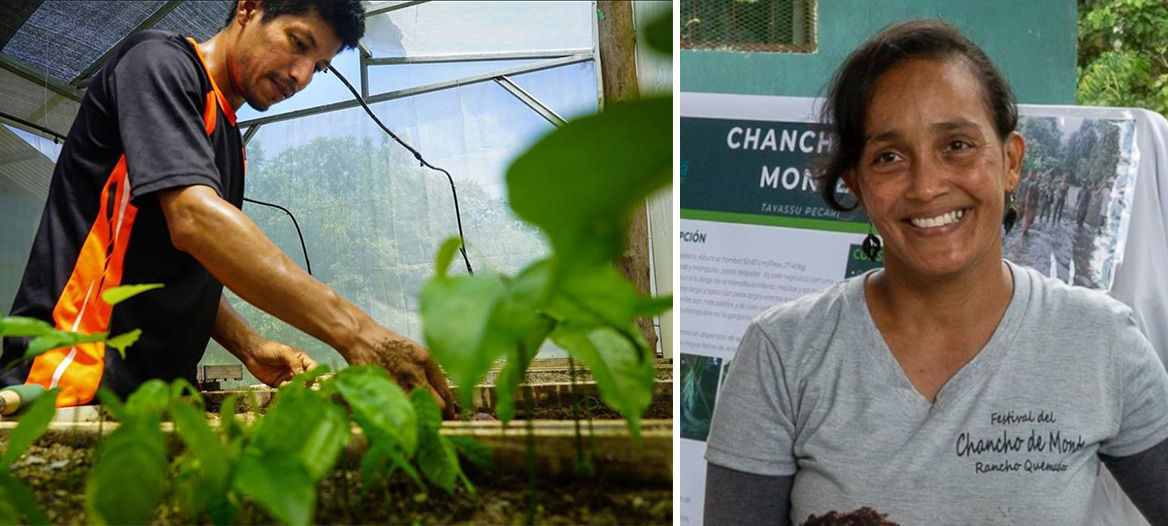
For the latter, they have a great approach. They are not buying up land. Rather, they are working with locals to teach them better, more sustainable and more profitable farming and ranching techniques with most of the emphasis on how they can help the locals run better businesses. 

Then, all they ask in return for this help is small slivers of land that can be reforested and opened to wildlife. 

Plants for reforestation; Photo: Osa Conservation
Since many of the practices they teach help framers/ranchers use land more efficiently, their clients are generally happy to cede edges of their property to help the environment. Many have actually become volunteers for Osa, helping to plant trees and educate others.

Ridge to Reef volunteers; Photo: Osa Conservation
In my next post, I’ll cover what we saw on our hikes.

We'll go for a walk to the beach

Trip date: March 9-27, 2022