Friday, July 30, 2021

Northwest Loop: North Cascades

Scott, caty and me at the prettiest National Park entrance I have ever seen

North Cascades is a National Park you don’t hear much about. Perhaps that is because little of it is accessible by road and much of it is inaccessible in winter because of the extremely steep avalanche-prone mountains. 

The steep mountain descends right into the lake
I drove through it once in 1992 and remembered very little except a high wall of snow lining the road. I have always counted it as a Park I had visited, but I always felt I was cheating just a bit. So, when Caty wanted to include it in our Northwest adventure, I was in. 

Map: NPS
Located in the state of Washington just a couple of hours northeast of Seattle, North Cascades National Park is actually part of an interconnected three-unit wilderness “complex.
” 

The complex also comprises Ross Lake National Recreation Area and Lake Chelan National Recreation Area. 

That area is surrounded by additional National forests and Canadian Parks. 

NCNP’s more than 500,000 acres protect the rugged mountain peaks of the North Cascades Range, the most expansive glacial system in the contiguous United States, the headwaters of several rivers and vast forests with the highest degree of plant biodiversity of any American National Park. 

Liberty Bell Mountain
But, as I said, most of it is not easily visited. Truth be told, we may not have actually set foot in the true Park in this visit, although we did get stamps at North Cascade National Park Visitor Centers and drive down Cascade River Road which does access the Park. 

A creek and falls on Cascade River Road
Most of the time, we were in Ross Lake National Recreation Area. It’s a bit confusing, but we’re counting it. 

A Hot Day
We didn’t have a lot of time to explore and, by the time we arrived at the Park, this year’s monstrous heat wave had also arrived. Temperatures reached 100 °F in an area where you might expect 70 °F at the most. So, in this case, our sightseeing-by-car system worked pretty well. 

The cool spray of a roadside waterfall was a nice foil to the heat
Look what I found!
We stayed at the Buffalo Run Inn on the edge of the Park in Marblemount. We expected the worst because it was incredibly inexpensive. But, it was quite nice and convenient. 

Marblemount is a tiny town with a couple of restaurants that had somewhat reduced service because of COVID, but it worked for us. 

Most of my experience in the Pacific Northwest was when I worked for GTE. imagine my surprise to find an old GTE sign still in place!

Drive-Through
We spent our day at the Park driving the main road, State Route 20, to admire the lush forests …
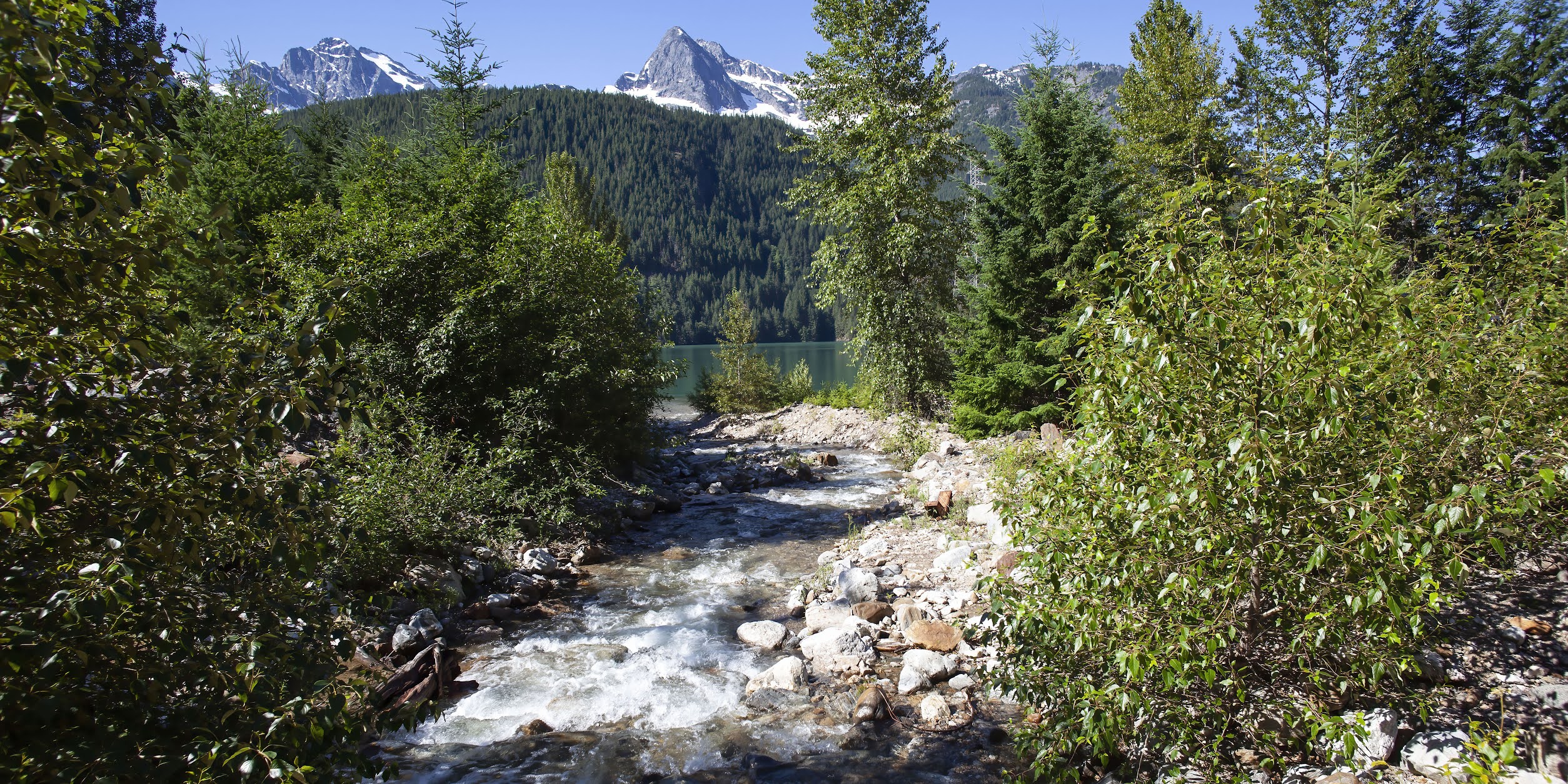
A creek winding through the trees
Waterfalls …

Lots of water flowing
Crazy beautiful lakes …

Diablo Lake -- no, this is not color-corrected
And rugged peaks … 

View from the Washington Pass Overlook
In the evening, we drove out the nearby Cascade River Road for a heavy dose of ferns ...

The primordial forest
Flowers …

The deep green is punctuated by lots of color
And flowing streams …

A rushing cascade on Cascade River Road
Skagit Artwork
About the Park 
So, here’s some background on the Park. 

The region was first settled by Paleo-Indian Native Americans. By the time European American explorers arrived, it was inhabited by Skagit tribes (the river that flows through the middle is the Skagit). 

By the early 19th century, the region was visited by fur trappers and, after the Canada-United States border was set at the 49th parallel in 1846, explorers came to chart potential routes through the mountains for roads and railroads. Limited mining and logging occurred from the late 19th century to the early 20th century, but the terrain made most endeavors nearly impossible. Thus, much of the area is still pristine.

A wide variety of plants
The first significant human impact in the region occurred in the 1920s when several hydroelectric dams were built on the Skagit River. Environmentalists then campaigned to preserve the remaining wilderness, culminating in 1968 with the National Park designation.

Ross Lake, one of several large lakes formed by dams
Most of the plant and animal species native to the Park region are still found there, though climate change and pollution from the west coast pose environmental risks. NCNP has one of the earliest and longest-lasting climate change research programs, primarily examining the effects of glacial retreat.

Photo: North Cascades Glacier Climate Project
NCNP is almost entirely protected as wilderness, and so the actual Park has few structures, roads or other improvements. There are not even any developed campgrounds. 

Erosion from water and glacial ice have created some of the steepest mountain ranges in the contiguous U.S. There is nearly 9,000 feet of vertical relief; the highest point is 9,220-foot-high Goode Mountain and the western valleys are only 400 feet above sea level.

"Rugged" is always used to describe the North Cascades
The Park is home to over 312 glaciers and 500 lakes and ponds. It contains the headwaters for streams that flow into the Skagit, Stehekin and Nooksack Rivers.

Mountain rivers and creeks
The North Cascades are a subsection of the Cascade Range that extends from northern California into British Columbia. 

The range is still uplifting
Unlike the volcanic mountains to the south, the North Cascades are primarily crystalline and metamorphic rocks, the oldest about 400 million years old. 

Rock formations have been repeatedly eroded, reburied and subjected to fracturing and heat, creating one of the most complicated and least understood geological records in North America. 

The region continues to see uplift and faulting. 

Many streams are feed directly by glaciers and thus carry finely ground rock particles commonly referred to as glacial flour, which remains suspended in the water, giving streams and the lakes they feed a bright but milky turquoise hue.

The silt gives the lake, in this case Diablo Lake, a milky turquoise hue
The hydroelectric power generated in the Park’s three dams supplies nearly 90 percent of the electricity used in Seattle. 

Ross Dam
NCNP has the most glaciers of any Park outside Alaska and a third of all the glaciers in the lower 48 states – an expanse totaling 27,000 acres as of 2009. Glacial volume has been rapidly decreasing due to climate change; in the past 150 years, ice volume has reduced by 40 percent. The heat wave we experienced probably did some additional serious damage. 

Photo: North Cascades Glacier Climate Project
Because very little of the Park was ever logged, almost half of it is old-growth forests. More than 1,630 species of plants have been documented within the Park. 
 
A ferny grotto
NCNP is home to 75 mammal species, among which are Wolverines, the endangered Gray Wolf and, possibly, the Grizzly Bear. NCNP is a prime Grizzly habitat, but the species was extirpated from the region by 1860. NCNP has management plans in place to return Grizzlies to the Park but not Wolves because the latter are seen as likely to reestablish themselves naturally over time.

Well, we did see one bear!
More than 200 species of birds pass through or use the park as a breeding ground, but we saw only Robins and Dark-eyed Juncos.

At least the only bird I photographed was a pretty one
At least 28 species of fish, including all five species of Pacific salmon (pink, chinook/king, sockeye, Coho and chum); seven species of reptiles; 12 species of amphibians; 250 species of aquatic invertebrates; and more than 500 species of insects have been documented in the Park. 

Flowers by a stream
Snow covers the ground more than six months out of the year, even at lower elevations, and State Route 20, the only highway through the park, is generally closed from late November until late April. Numerous avalanche chutes, as many as traverse any state or federal highway, and including some over 2,000 feet long, cross the highway and make snow removal during that period infeasible. 

Photo: Outside Magazine
A Really Quick Overview
Our visit was rather uneventful, as I said. We traversed State Road 20, once up to Washington Pass and once all the way through. 

Washington Pass
The evening we stayed in Marblemount, we also drove out the secluded gravel Cascade River Road that eventually reaches into the Park. It was cool and lovely, with lots of flora – but no fauna. 

Foxgloves are a common and colorful plant
Then, we left the next morning by driving east and then south around the bottom, heading back to Seattle. 

Summer playground; Photo: TripSavvy.com
Although the park was relatively uncrowded, we found out where all the people were: Lake Chelan National Recreation Area. 

It was full of boaters, swimmers and windsurfers. 

One thing we would have liked to do, but didn’t have time for was to take a ferry up narrow Lake Chelan and stay at a rustic Lodge at Stehekin. 

There are two different routes (it was unclear whether both were currently running): a leisurely four-hour narrated tour and a 90-minute express ferry. 

Maybe next time! 

Photo: the Lodge at Stehekin
Deception Falls 
The way back to Seattle was very pretty with a number of waterfalls and scenic vistas. We stopped at Deception Falls, an absolutely astounding waterfall. 

Deception Falls at the bridge
Not for its height or width, but for its raw power. I would not have expected such intensity in such a small waterfall. See it here.

Caty and I walked the half-mile interpretive trail and a little bit further on a connected hiking trail. 

The trail crosses and follows the creek
Near Stevens Pass, Deception Falls drops 94 feet from Deception Creek into the Tye River. 

One of the lower falls
Allegedly the falls can run dry in the late summer, which is hard to believe at the height of heat-wave-induced snow melt. 

Flowing through the woods
It was a nice soul-calming break on our drive back to the heat and bustle of Seattle. 

A lot of Pacific Northwest plants
End of the Core Trip
The next morning, Caty flew home with another National Park and a pod of Orcas checked off her to-do list. 

Wildlife, scenery and culture; a good trip
And, instead of heading south to Oregon as we had originally planned, we headed east toward Glacier National Park to get out of the heat and see what we could see.


Trip date: June17-July 2, 2021

Thursday, July 29, 2021

San Juan islands: Whale Watches

What we were looking for
While in Friday Harbor in the San Juan Islands, we went on three trips with Maya’s Legacy Whale Watches, a local company that specializes in small-boat tours. 

The boats are small so you can get close
The company is the “descendent” of Jim Maya’s whale-watching business. Scott and I and Caty went out with Jim on separate trips in 2012 and we really liked the friendly, casual and intimate nature of these trips. Maya’s Legacy was created when Jim sold his business; we hear he sometimes still leads some of the company’s tours. 

Maya's is convenient; it sails right from Friday Harbor
Prior to the trip, we were told there would be two COVID-related changes. First, we had to wear masks the whole trip. That turned out to be fine, except for some occasional glasses fogging. Second, our boat had to stay in U.S. waters and could not even cross the Canadian border. Normally, they can follow Orcas between the two countries.

The trips can cover quite a bit of distance, depending on where the Orcas are

Oh no!
Whale Watch #1
Our first whale watch was an evening tour the day we arrived. 

Remember, this was summer very far north. It doesn't get dark until after 10:00 p.m. 

A great trip, but we didn’t see any Orcas! 

Was the Caty curse going to continue? 

Whatever ...
It was a lovely cruise where we saw several Bald Eagles, including a nest occupied by an Eaglet and guarded by one of the parents …

The San Juans have at least 125 pairs of nesting Bald Eagles
… a very regal Juvenile Bald Eagle …

Eagles are everywhere in the San Juan Islands
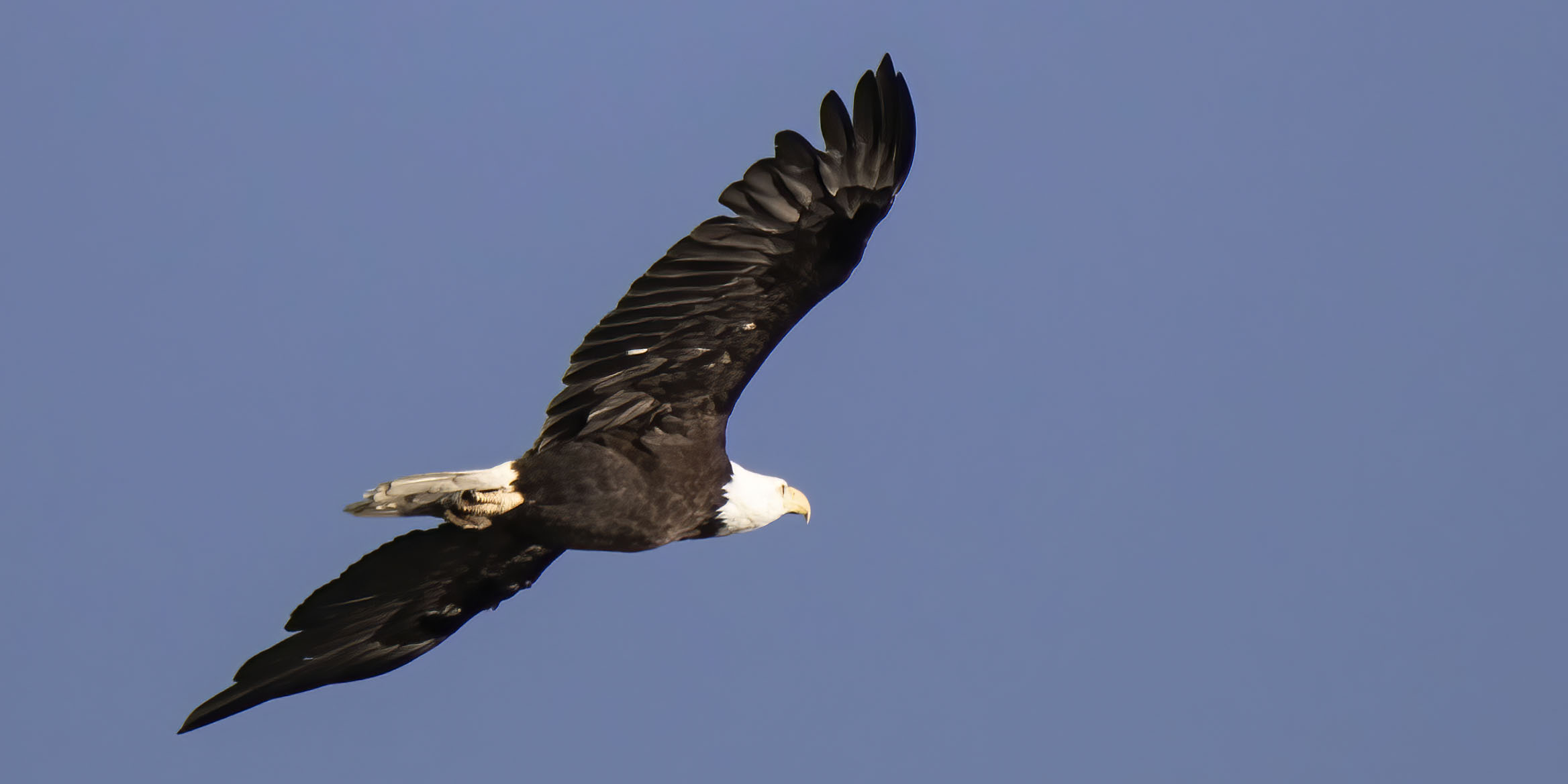
... and another adult that flew to a tree ...

Bald Eagle in flight
... and treated us to song (if you can call an Eagle’s screams a song) …

Vocalizing for us
We saw Steller Sea Lions, starting with a group posing on a buoy. It’s a bit of a cliched look, but this is how you often see Sea Lions.

Just chillin'
And, in this case, the late afternoon light was spectacular …

Showing us his best side and his heart-shaped scar
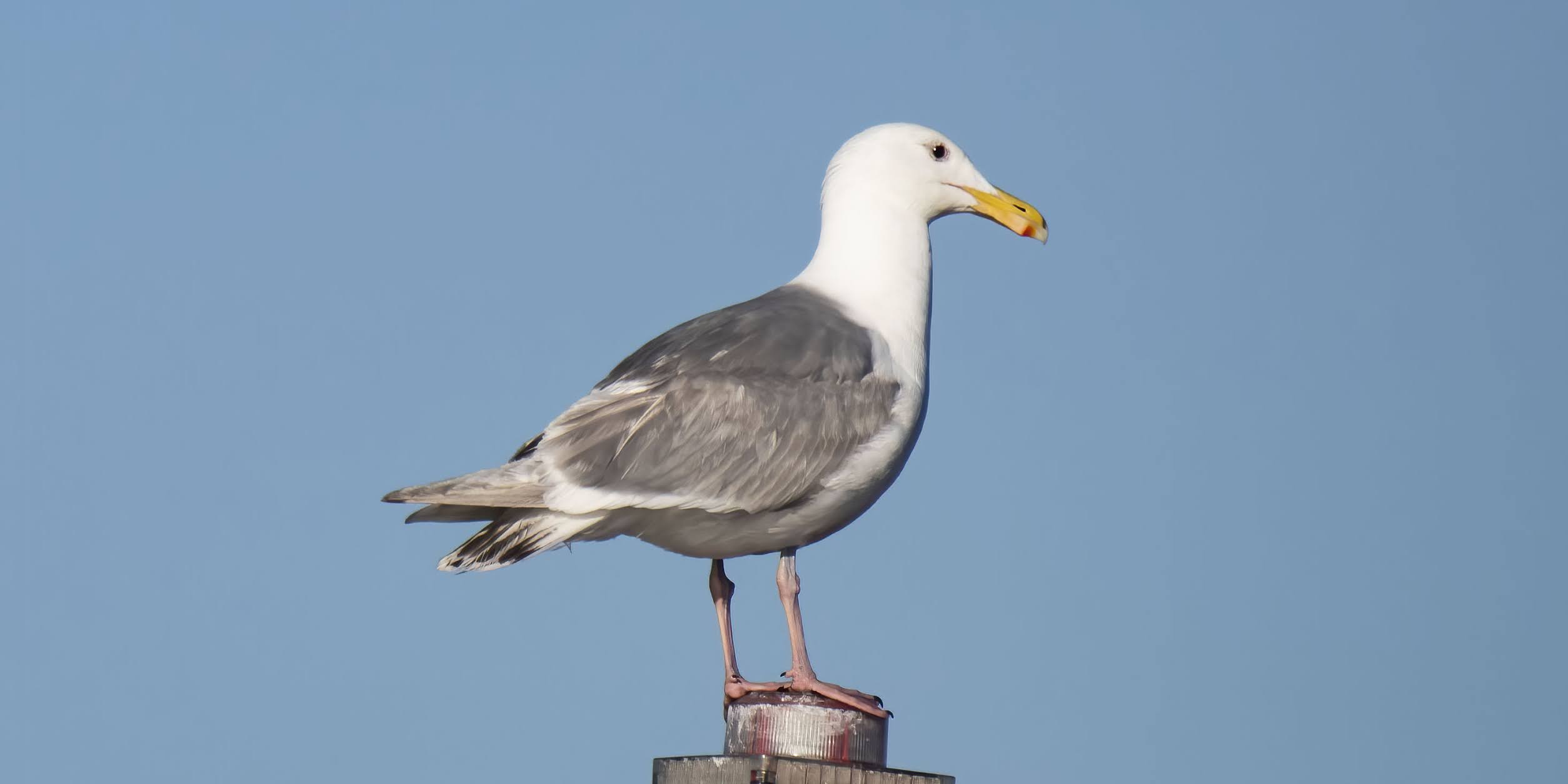
… for the Glaucous-winged Gull, too ...

Each buoy gets a gull finial
Later, we saw some flocks Rhinoceros Auklets and I got one quick shot of one on the water with a mouth full of fish before it dove for more fish. 

Iconic Auklet looks: flying and fishing
Our guide said that they fish in the late afternoon and earlier evening so our next best opportunity to get a photo with a mouth full of fish would be the next evening when we had another whale watch scheduled. 

We saw Black Oystercatchers … 

One of three types of Oystercatcher I have seen: Black, American and Eurasian
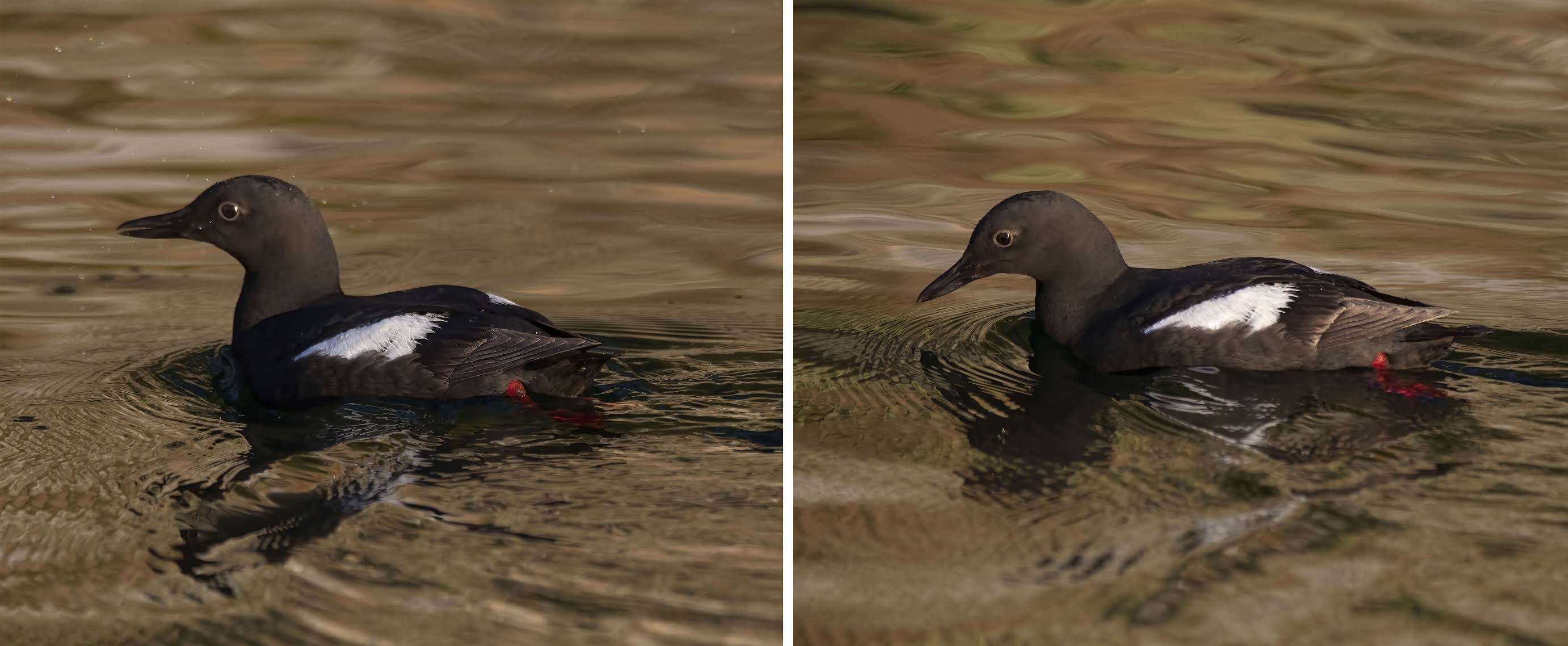
We saw lots of Black Guillemots … 

We came across quite a few of these lovely birds
… with their adorable red feet … 

They also have bright red inside their mouths, but I never saw one open its mouth
In fact, it was these birds that won the day … 

It was sunset; I like this dark look
They are very photogenic … 

Photogenic, but sometimes a bit goofy
… and I got lots …

They have to "walk" across the water to lift off
… and lots …

Finally airborne
... and lots ...

This kind of fishing is called "dabbling"
… of good shots … 

The lovely Black Guillemot
Late in the trip, when it had become evident that Orcas just weren’t going to show, we saw a group of Harbor Seals, hauled out on a rock, enjoying the surf …

Hidden away in a dark cove
… surrounded by some in the water …

Harbor Seals are found north of the equator in both the Atlantic and Pacific 
... and a few more that looked as though they were levitating ...

A roly-poly little guy
... they lifted their tails and appeared to smile every time a wave crashed on them … 

 They favor coastal waters, rocky islands, sandy beaches, mudflats, bays and estuaries
The way they were posed, they reminded me of the tableau that ballerinas form ...

Look at those faces!
Out on the water, we had lovely views of the Patos Island Lighthouse, both as we were heading out …

A cute little lighthouse
… and coming back … 

A spectacular backdrop
And, in the far distance we could see 10,778-foot-tall Mount Baker on the mainland (and before you think that’s not so tall compared to our 14ers, remember that that almost 11,000 feet is rising from sea level) … 

You are seeing more mountain than 14ers in Colorado
It was a beautiful evening with some spectacular wildlife. But, no Orcas. 

We were concerned, but decided to keep a positive attitude. Tomorrow was another day! 

Another day for Caty with no Orcas
Whale Watch #2 
Early the next morning, we were at Maya’s waiting for our half-day whale watching trip. Sure, we hadn’t seen any the night before, but we were confident. 

Photo: Maya's Legacy
The boat is a small one with covered seats in the middle, an open back deck and a small amount of seating a viewing area on the bow. 

There were windows in the covered area, which the crew would flip open if we were stopped to view something. 

The first night, Caty and I had spent almost all the trip on the back deck. I do not like to be inside, ever, even if the windows can be opened. 

Sara, our naturalist
This time, Caty and I decided to sit on the bow, which afforded better 180+ degree visibility. From the night before, we knew that the ride should be fairly smooth. 

The first night, we had headed north. This time, we were moving south. As we approached a nice view of a lighthouse, I assumed that the captain would turn toward the lighthouse to give us good photo ops. 

But, he didn’t. He sped up and passed the lighthouse. It was a somewhat harrowing ride with back-jarring slams into swells as we held on for dear life. He must have gotten a radio report of Orcas. 

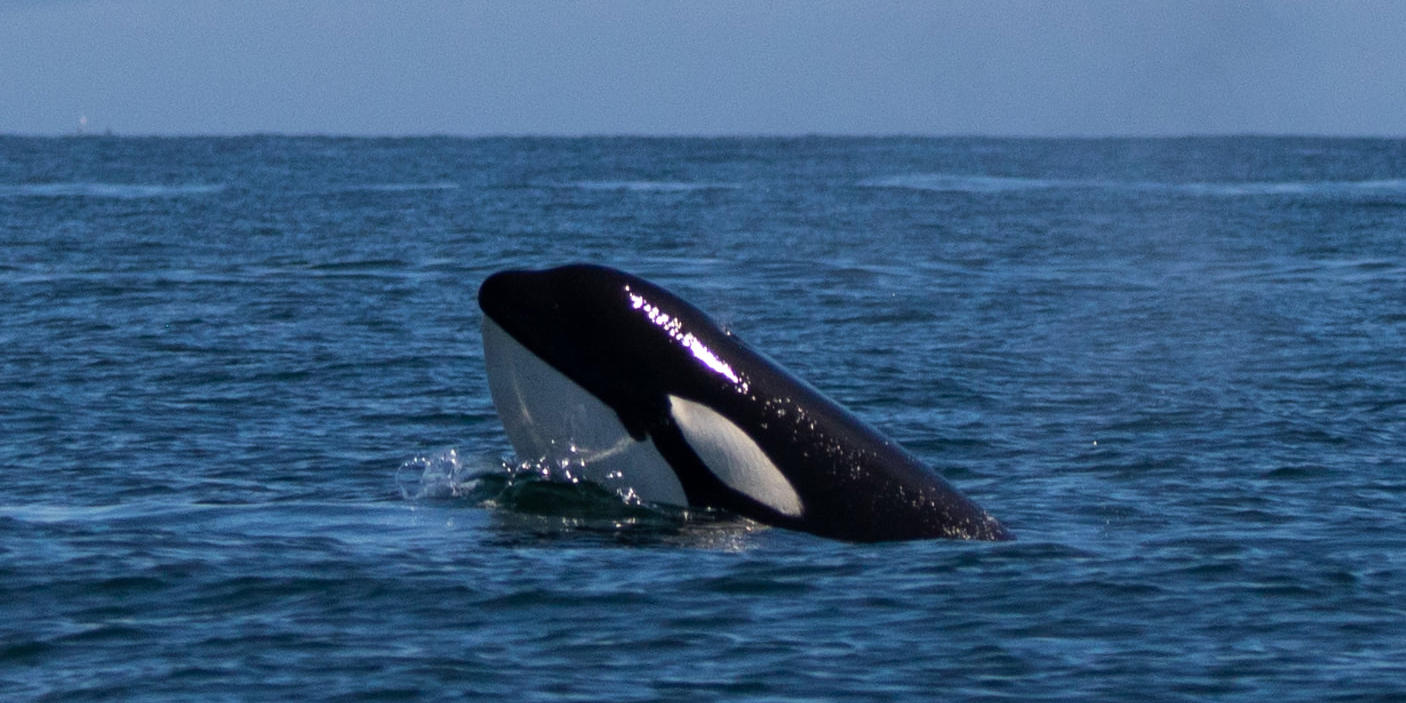
And, indeed he had. We saw them at a distance, in the midst of some pretty spectacular activity … 

This looked promising
Then, we moved closer among other whale watching boats – some from the San Juans, some from Port Townsend on the Olympic Peninsula and one other Maya’s boat (it was an all-day tour that was sold out when we tried to book). 

Everyone got a great view
As we approached, one breached right in front of us. It happened so quickly, practically no one got the shot. But, Scott did.
 
Orca breach; Photo: Scott Stevens
What transpired after that was a jumble of activity. I am not posting these photos in any particular order; that would be just too difficult to recall. 

Orca tail
There were at least six, probably seven Orcas. And, they were active. 

It's hard to count, but there are at least six in this photo
There was lots of tail-slapping … 

No one knows why they do this; probably trying to attract the boys
Sometimes solo … 

Twisting and slapping
Sometimes in tandem … 

A male and a female
There was one really nice roll-over … 

A nice view of the underside of an Orca
We saw several breaches and some semi-spy-hopping. I managed to get only these two blurry photos of that activity ...

My worst best photos
Caty did better ... 

Orca breach; Photo: Caty Stevens
And, I even told Caty to expect breaches after a deep dive and I missed it! She got it, though. 

Coming out of the water; Photo: Caty Stevens
I had to pull back on my 600mm lens because it was so hard to keep the fairly close whale in my focal area.

They were close and very active
The Orcas included a number of females, identifiable by relatively small dorsal fins .. 

The female's dorsal fin is small and hooked; there are three in this photo
… and two males, obvious because of their tall dorsal fins … 

The male's dorsal fin can be 6 feet tall
But, the naturalist knew more about the two guys than just their sex. Orcas can be positively identified – and thus, tracked – by markings on their saddlepatch (the white area over the back), eyepatch, tails and fins and by scars. 

Each Orca is unique

Ted's mark
Each known whale is given a number to help tracking. These were brothers from Alaska, who traveled together, frequently coming to the San Juans for a variety of excellent adventures. T128, born in 1988, was affectionately known as “Bill” and his baby brother, T125A, was born in 1998 and is known as “Ted.” 

Ted is very distinctive, with a huge dorsal fin that has a sizeable chunk -- perhaps a bite -- out of it. 

It was such a fun time, watching this group cavort. 

A female tail-slapping before a dive
Success for Caty. The Orca curse is over. 

Ted approves!
With all the whale watching, we didn’t have time for much of anything else. But, we did see some equally rambunctious sea lions. They were barking… 

Sea Lions have larger-than-life personalities
... rough housing ...

These were play-fighting, so there was no real damage
... and splashing ...

Into the water after the tussle
Plus, some were just watching us from a small rock island … 

Minutes later, the lower one dove in
We also saw a Double-crested Cormorant rookery … 

This was mainly Double-crested with a few Pelagics mixed in
A Bald Eagle keeping watch on a channel marker near the harbor ...

Guarding the harbor
And, oh, the scenery … 

A view of Mount Baker enhanced by an Orca
Whale Watch #3 
A brief break and we were off again, for our final whale watch – a repeat of the evening tour we had done the night before. And, unlike our morning trip, we headed north because there had been some reports of Orca activity in that direction. 

All the captains talk to each other about where the Orcas are
Sure enough we found two Orcas. 

Success again!
It was Bill and Ted again! Thirty-five miles north of where we had seen them just hours earlier! 

There's that missing chunk again
That illustrates how quickly these animals can swim! 

T128 and T125A from Alaska
These boys do like their adventures … 

The ferry passes behind the boys
Whoa! 

Bill taking a breath
This time there were no ladies. That may have been why Bill and Ted were much more subdued, just generally swimming about. 

Ted and Bill side-by-side
And, while they were not as entertaining, they were much, much closer. 

I could even look him in the eye
I had to switch to my wide-angle lens for some of the shots. 

Surfacing right by the boat
It very exciting for Caty, who finally got to see her Orcas … 

Caty photographing Ted
After a great show, we had to head back, stopping briefly for views of Cattle Point Lighthouse, which is on San Juan Island ...

Cattle Point Lighthouse
… and to spend some time with Harlequin Ducks (tricky to photograph and even harder to see because it was almost full dark) …

Female Harlequin Duck
We saw Steller Sea Lions on an area called Whale Rocks …

Watching us as we watched them
... a hauled out group of Harbor Seals ...

Catching the last rays of the day
... a Bald Eagle ...

Is he judging us? I think he is judging us
… and a final treat, which I had asked the captain to find after my one poor shot of the first whale watch: a Rhinoceros Auklet with a mouth full of fish … 

Such a cool shot
They are called “Rhinoceros” because during breeding season they have a short spike at the base of their bills. 

You can see the spike here
It was a lovely evening.

A Sea Lion enjoying a beautiful summer evening
Another success! 


San Juans, I love you! 

A good day
About Orcas 
I have blogged about Orcas before, but here are some facts (edited for length) from Oceana, a charitable group that protects the world’s sea life: 

Orcas get their nickname "Killer Whales" from their reputation of being ferocious predators.
 
San Juan Islands, 2021; Photo: Caty Stevens
They are actually very large dolphins, reaching lengths of 33 feet and weights of at least 22,000 pounds. 

San Juan Islands, 2021
Thought to be some of the smartest animals on the planet, they are extremely curious and often approach people to investigate. 

San Juan Islands, 2012
They generally live in small groups and organize complex group behaviors when mating and hunting. 

Alaska, 2018
Orcas are the most widely distributed cetaceans (Whales, Dolphins and Porpoises) and can be found in every ocean.

San Juan Islands, 2021
Male orcas live up to 60 years, while females live much longer, up to 100. 

San Juan Islands, 2021
Juveniles can swim from the moment they are born, but they are totally dependent on nursing their mothers' milk for one to two years. 

Alaska, 2018
Pods usually range from three to 20 members. 

Alaska, 2008
Orcas pass down specific communication and hunting skills to younger members, distinguishing one pod's culture from another. 

Alaska, 2018
Although all Orcas, worldwide, are considered to be members of the same species, recent research suggests, based on appearance, habitat and diet, there may be as many as 16 different species. 

Alaska, 2018
Orcas have never been known to attack humans in the wild, but captive Orcas have killed several trainers, most likely from the stress of being confined in small, inadequate spaces. 

San Juan Islands, 2021
In the U.S. and some other places, Orcas are given complete legal protection. 

San Juan Islands, 2021
Many Orcas live in the San Juans year-round and some migrate to the from Alaska, including Bill and Ted.
 
San Juan Islands, 2021
Orcas tend to “arrange” themselves by their diet, seldom, if ever, changing what the eat. 

Alaska, 2018
There used to be a fair number of Orcas in the Northwest that ate exclusively salmon, but, with a precipitous decline in salmon, these pods have all but disappeared. Now, most of the Orcas eat Sea Lions and Seals. Those pods are doing quite well. 

San Juan Islands, 2021
In the past, Orcas have been defined as “resident” or “transient,” but those labels aren’t entirely accurate because some “resident” Orcas move about and some “transients” stay put. I’m going to let the naturalists clarify their designations before I even try to define Orcas. 

San Juan Islands, 2021
The Ferry Back 
The next morning, we returned to the mainland via the ferry. 

The Washington State Ferry
This was our final maritime experience of this trip. It was a beautiful ride, punctuated by some Rhinoceros Auklet sightings … 

These little guys are so cute -- and fast
One Harbor Seal … 

He swam with us for awhile
And, some beautiful scenery. 

Mount Baker from the ferry channel
A successful visit. 

Caty and me enjoying Friday Harbor's weather
Coming up: North Cascades National Park.

Next stop!

Trip date: June17-July 2, 2021