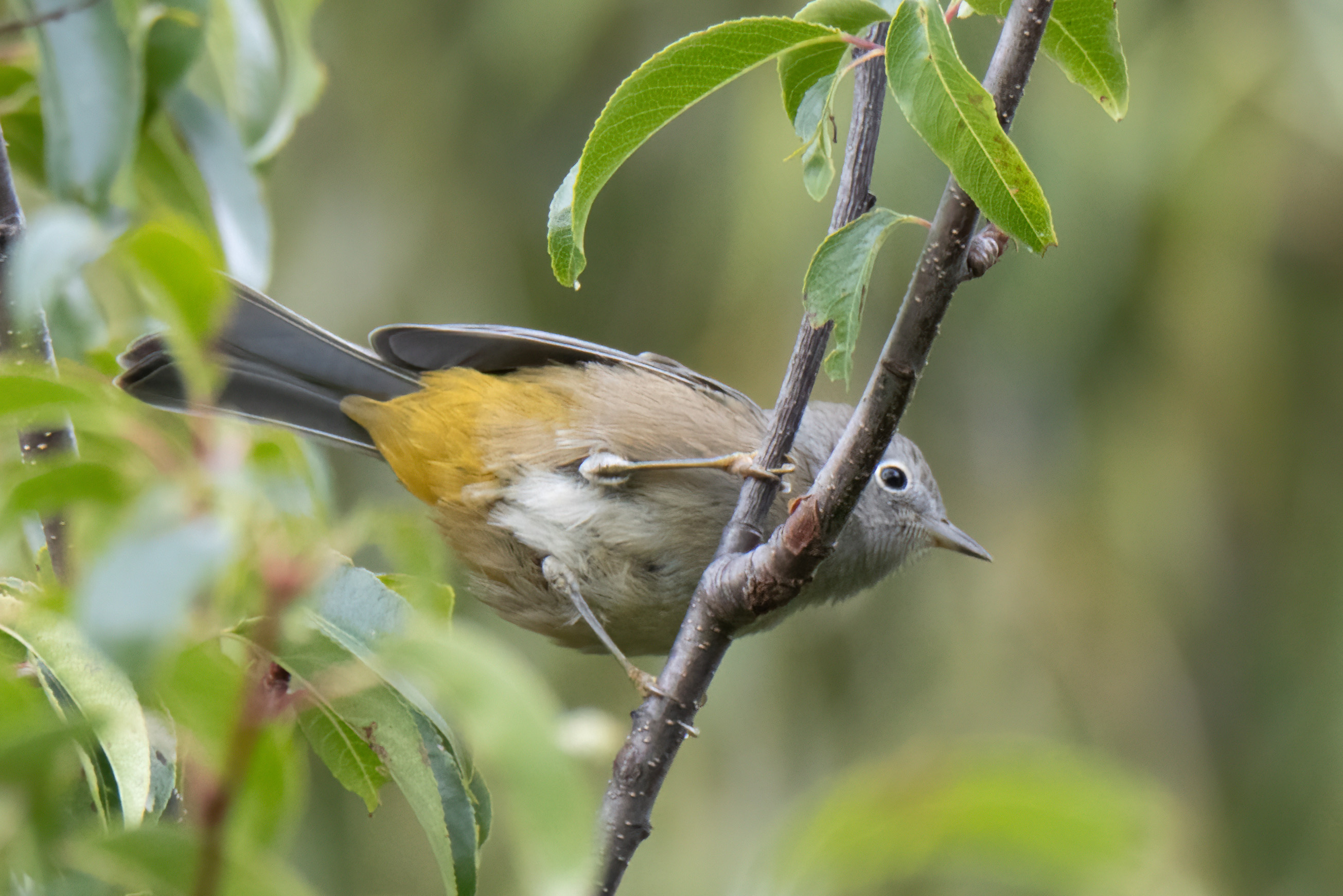
 |
| A trip built mainly on finding one small bird |
 |
| Rene, me, Susan and Heather |
I didn't have any birding trips planned, so I said yes.
Susan had planned to take this trip a few years ago with friends Michele and Kathy (whom I birded with in 2019), but she broke her leg and couldn't go.
So, this trip was with the same guide, Rene Valdes (RV Birding Tours), just different companions.
 |
| The plan |
The agenda looked like this:
Depart July 5 and fly (via DFW) to Monterrey and spend the night there.
 |
| Desert and mountains |
Spend July 6 birding the Chihuahuan desert to look for Worthen's Sparrow and other desert specialties.
Move on to the montane forest of the Sierra Madre Oriental to look for pine forest target species including Hooded Yellowthroat, Colima Warbler, Pine Flycatcher, Russet Nightingale-Thrush and others.
Then, drive on to Cumbres de Monterrey National Park. We would spend the night in cabins at Mesa del Oso at 8,000 feet with possibilities for night birding for Owls and Nightjars.
Spend July 7 birding Cumbres de Monterrey, including a nesting cliff for Maroon-fronted Parrots. Then, head back to Monterrey, stopping at La Estanzuela Natural Park.
 |
| A Maroon-fronted Parrot and a Green Jay |
 |
| Variety |
On July 8, head to the mountains overlooking Monterrey and bird the Parque Ecologico Chipinque for a few specialties and then drive about 250 miles to Gómez Farías town at the base of the cloud forest El Cielo Biosphere Reserve. In the evening, we would bird the lowlands including a boat trip along a river looking for Sungrebes and Amazon Kingfishers. We would also visit agricultural areas to look for Aplomado Falcons, Tamaulipas Crows, Double-striped Thick-Knees and Altamira Yellowthroats. We would sleep at Casa de Piedra in Gómez Farías and do some night birding, looking for Tawny-collared Nightjars, Northern Potoos and Mottled Owls. The next day would bring more birding in El Cielo, driving up the mountain in a 4x4 truck to the village of Alta Cima and then back down for a second night in Gómez Farías town.
On July 10, we would bird the Gómez Farías-El Azteca road in the morning, looking for Thicket Tinamous, Great Curassows and the endemic Altamira Yellowthroat.
 |
| Mountains and fields |
Then, back to Monterrey before leaving for home on July 11.
I realized after I agreed to the trip that we may be seeing a lot of the same birds we saw in Costa Rica in 2022, but there were still about 100 new possibilities (and maybe better photos of some of the repeat birds).
 |
| Roadside Hawks in Mexico and Costa Rica |
I went to England and Wales with Caty June 6-20 and to a music festival with Scott June 28-30, so I didn't have a lot of time to get ready. As I was thick in the midst of packing, including spraying my clothes with permethrin insect repellent, Rene sent us a note asking if we would mind changing the trip around in anticipation of Hurricane Beryl.
What???
I knew that Hurricane Beryl was the earliest Category 5 storm on record and I vaguely knew it was heading across the Caribbean.
 |
| But, yikes, it was plowing directly towards where we were going |
After discussions with Susan and (through her) Heather, we asked if we could postpone. Our thinking was that, even if the storm mellowed, as it was expected to do after slamming into Cancun, we would probably have rain and generally miserable weather. Plus, if it did re-intensify, we would be in Mexico in the middle of a disaster.
Rene was amenable and, so, we changed to August 12-18.
I rebooked my airline ticket (even got a refund credit because the new flight was cheaper) and watched as that damn storm took a big turn and completely missed Mexico's mainland!!! Oh, well!
 |
| Where it went |
So, we went in August. It was a good trip. I saw 140 species, of which 34 were lifers. We didn't see many of the target birds, but we did see the Colima Warbler. So, Susan was happy.
And, even though Beryl didn't hit, some of the areas we went had been severely hit by Alberto in June, causing massive floods and washing out lots of roads, including the roads to the Maroon-fronted Parrot nest site and to our cabins in the mountains.
 |
| I wasn't paying attention when this happened in June; Photo: Reuters |
Rene regrouped a bit and I'll go through the agenda throughout the blog.
 |
| Heather front and center |
Heather had just returned from a lengthy trip to Madagascar and contracted a stomach bug (as often happens with this type of travel). She almost canceled, opting instead to arrive a day late.
Fortunately, she recovered somewhat and seemed fine during the trip. I am glad she made it, even though she missed Day 1. She is one of the best bird-spotters I have ever met.
About Monterrey
We hardly spent any time in Monterrey, but here's some basic information.
The capital and largest city of the northeastern state of Nuevo León, Mexico, Monterrey is the ninth largest city and second largest metro area in Mexico behind Greater Mexico City. It has more than 5 million residents and has been rated as the city with the best quality of life in Mexico.
 |
| Flying into Monterrey |
It sprawls across a valley surrounded by magnificent incredibly steep mountains. It seems clean and modern. The most we saw of it was our hour-long drive from the airport to our hotel for the first two nights, the Antares in the neighboring (and upscale) town of San Pedro.
 |
| A modern city |
Located at the foothills of the Sierra Madre Oriental, Monterrey sits at 1,770 feet above sea level. The Santa Catarina River, which is dry most of the year on the surface but has flowing underground water, bisects the city into northern and southern halves. The river was dry when we passed it, but there was still some evidence of the June storm that flooded it.
Monterrey is one of the warmest major cities in Mexico. The average in August is 75°F- 97°F. And, it was cool compared to our more southerly adventures later on. Tell me again why we didn't go in January?
 |
| The green mountains and clouds fool you unto thinking it is cool |
The night Susan and I arrived, Rene picked us up and it took over an hour to reach the hotel. Because it was fairly late, we ate in the restaurant there (snacked actually because they were out of everything we wanted), slept and left early the next morning to start looking for birds.
About Rene
Our birding guide, Rene Valdes, was delightful.
 |
| Rene Valdes; Photo: BirdsEye |
A wildlife biologist, his main vocation is working as an environmental consultant for wind farms across Mexico. He grew up in Mazatlán on Mexico's Pacific coast, but attended college in Monterrey and worked there for years before returning to Mazatlán. He has two daughters in Monterrey, so visits (and birds there) often. His master's thesis was on the rare endemic Maroon-fronted Parrot, so he is an expert.
Since it was so hot, he planned a trip that was exclusively birding by car. That was great because Susan has some significant mobility issues and hiking would not be an option.
 |
| You can see a lot from the road |
So, let's go to Mexico!
Warning: this was a birding trip, not a tour. So, most of what I talk about is birds.
Valle de Soledad
Our first morning of birding was along Camino a La Hediondilla in Valle de Soledad in the Chihuahuan Desert, southwest of Monterrey.
 |
| Our first birding stop |
It took us two hours or so to drive to the desert. This is where we actually saw what Monterrey is. Lots of manufacturing plants and more trucks than you can imagine. The major trucking route from Mexico City to Laredo, Texas, passes through.
 |
| From what I could see, commerce is good |
We stopped for breakfast at a roadside restaurant that seemed to offer only exclusively egg dishes. I hate eggs, so I had a quesadilla.
 |
| Simple |
Unlike American quesadillas, this was just two small corn tortillas folded around a clump of slightly warm white cheese. I had some avocado on the side and liberally doused the thing with salsa. I was trying to follow the recommendation to not drink the water or eat raw vegetables except those with skins. That meant lots of avocados, no tomatoes and bottled water and diet cokes. I ate salsa and am still unsure as to whether that was a good idea. Although convenience stores carried bottled iced tea, it was all sweetened. So, my options were limited. As we started out, I had no idea that restaurants all serve pretty much the same thing anyway.
Valle de Soledad, a wide expanse of sparsely populated land (hence the name, which means "Valley of Solitude"), is in the Chihuahuan Desert.
 |
| Valle de Soledad |
The largest hot desert in North America, the Chihuahuan Desert covers part of northern Mexico and the southwestern United States, occupying much of far West Texas, the middle to lower Rio Grande Valley and the lower Pecos Valley in New Mexico and a portion of southeastern Arizona, as well as the central and northern portions of the Mexican Plateau.
 |
| Map: National Park Service |
It is bordered on the west by the Sonoran Desert, the Colorado Plateau and the Sierra Madre Occidental range, along with northwestern lowlands of the Sierra Madre Oriental range. Its largest continual expanse is in Mexico, covering much of the state of Chihuahua, along with portions of Coahuila, northeastern Durango, the extreme northern part of Zacatecas and small western portions of Nuevo León.
 |
| We were in the Nuevo León section |
The Chihuahuan Desert covers an area of about 193,783 square miles (bigger than California).
The terrain mainly consists of typical scrubby desert basins broken by small mountain ranges that create "sky islands" of cooler, wetter, climates. It is biologically diverse with many endemic species.
Grazing and agriculture have badly degraded many areas, killing off native grasses and replacing them with creosote and mesquite. The Mexican wolf, once abundant, was nearly extinct and remains on the endangered species list.
 |
| The livelihood is part of the problem |
It is mainly a "rain shadow" desert created by mountain ranges that block moisture from the Pacific Ocean and the Gulf of Mexico. It mostly has an arid climate with one rainy season in the late summer and smaller amounts of precipitation in early winter.
 |
| A rare body of water |
Because of its inland position and elevation (1,575 to 5,906 feet), the Chihuahuan Desert has a slightly milder climate in the summer than other North American deserts (daytime June temperatures are in the range of 90°F to 104°F), with mild to cool winters and occasional to frequent freezes.
Valle de Soledad has lots of yucca, Mexican fire-barrel cactus, cholla and grasses. Recent rains had also created a somewhat rare carpet of yellow flowers.
 |
| Beautiful! |
Mexico, including the desert, certainly delivers on butterflies. There were thousands, primarily Checkered Whites, in Valle de Soledad.
 |
| A Checkered White enjoying the flowers |
The United Nations reported in 2006 that nearly half of the bird, mammal and butterfly species in the Chihuahuan Desert are expected to be replaced by other species by 2055 due to climate change.
Most of the birds we saw are birds I have seen in the deserts of Colorado, New Mexico, Arizona and Texas, including these that I didn't photograph: Eurasian Collared-Doves, Rock Pigeons, White-tipped Doves, a Swainson's Hawk, a Say's Phoebe, Common Ravens, Horned Larks, Barn Swallows, House Sparrows, a Red-shafted Northern Flicker, Cassin's Sparrows and Lark Sparrows.
I did get pictures of lots of birds; here are some ...
 |
| Female Golden-fronted Woodpecker |
 |
| Canyon Towhee |
 |
| Curve-billed Thrasher with its face stained by cactus fruit |
 |
| Cassin's Kingbird |
 |
| Loggerhead Shrike |
 |
| Greater Roadrunner |
 |
| We saw about 50 Long-billed Curlews |
 |
Three Crested Caracaras in a distant tree |
 |
| Bewick's Wren building a nest |
 |
| Female and male House Finches |
 |
| Male Lesser Goldfinch |
 |
| Doves: White-winged and Mourning |
 |
| Northern Mockingbird |
 |
| One of several Ruby-throated Hummingbirds (so hard to see as they flitted about) |
 |
| Scaled Quail |
 |
| Turkey Vulture |
 |
| Western Meadowlark (there were so many!) |
We saw about a dozen Burrowing Owls living among a new animal for me, the Mexican Prairie Dog.
 |
| Mexican Prairie Dog |
Although I have seen many, many Burrowing Owls in my life, I had struggled to find many during the summer of 2024. So, it was nice to get some up-close shots.
 |
| Not new by a longshot, but fun |
We never found a Worthen's Sparrow, but I did get one lifer, a Botteri's Sparrow.
 |
| Botteri's: We saw it only briefly and my photo is awful |
It was a fun morning of birding but not terribly productive in terms of lifers.
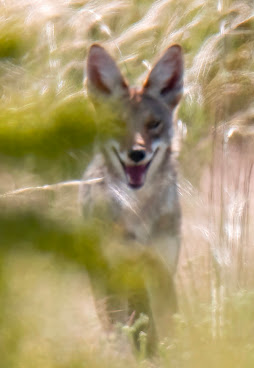 |
| This one had a clown-like face |
We also saw two Rio Grande Coyotes, hidding behind some low bushes (maybe creosote).
This is the same species I had seen in South Texas in April. They were hunting (and catching) a rabbit.
After about three hours of birding, we headed off for lunch and birding in the cooler mountains. Although we eventually got there, we had to endure about three hours stuck in a massive traffic jam caused by a perfect storm of high truck traffic, construction and two bad truck accidents.
We were afraid we would also have a perfect storm of rain as we watched typical afternoon clouds build and rain and lighting over the mountains we were heading to.
 |
| Looking threatening |
But, the traffic jam may have saved us there, because the rain was gone by the time we finally got where we were going.
Trip date: August 12-18, 2024