Friday, September 25, 2015

September in Alaska #2 -- Kenai Fjords

The next morning, we considered doing a Prince William Sound cruise (26 Glaciers in One Day!!!), but the weather looked iffy, so we headed for Seward. 

Typical Alaskan weather
Fall on the Kenai is spectacular. We stopped to admire several vistas along the way.

Fall
Its beauty made me wonder why we haven’t spent more time there. Scott did remind me that it is ridiculously crowded during the summer, with fishermen standing on top of each other (picture below).

So much for the solitude of fishing
Our original plan was to go to the Sealife Center, a great aquarium and sea life rescue facility, in Seward. But, the weather cleared somewhat and the timing was right, so we took a Kenai Fjords cruise. 

Cruising
There are several providers that cruise into Kenai Fjords National Park. We have always gone with Kenai Fjords Tours. We have always been satisfied with the boats, the tour guides, the number of people on board. 

We just keep coming back
This cruise leaves Seward and heads into Kenai Fjords National Park, which contains many of the nearly 40 glaciers that flow from the massive Harding Ice Field.

The route
I have done this cruise five or six times (the first one was in 1990 during my second business trip to Alaska). This trip was among the worst for weather (I said we were paying dues), seas (we had some pretty rough moments) ... 


... and glaciers (not much, but some, calving) ...

Calving glacier
But, the Whales were good – we even saw a Humpback breach, which I didn’t get on the camera. We did see plenty of flukes. Although many Humpbacks had already left for warmer birthing and breeding grounds in Hawaii, some remain all year and some linger to fatten up before they head south. These were stragglers and remainders.

Fluke
Even though most of the Puffins had departed for the season (they migrate to British Columbia and even points farther south in the winter), we did see a few. Puffins fly very fast and are extremely difficult to photograph. 

This is my best!
We also saw Sandhill Cranes on their way south (they travel to the southern U.S.).

In formation
And, we got very close to Sea Otters ... 

Just chillin'
... and saw some great Steller Sea Lions.

More chillin'
Our trip was aboard the Callisto Voyager  ...

Our boat
... a double-hulled boat that took the waves pretty well.

The trip took us from Seward Harbor through Resurrection Bay, where we immediately saw two Bald Eagles ...

Looks like a mated pair, female on the right
... one of which flew for us ...

Fly-by
Then we went down the bay ...

Looks gloomy
... stopping to watch a crazy surfer (that water is very cold, around 50 degrees away from the ice, colder as it nears the glaciers) ...

Brrrrrrrr
 ... past Cheval Island (named because it allegedly looked like a horse - I don't see it) ...

Do you see it?
... and then up Aialik Bay to Aialik Glacier, a new glacier for me. 

A big one
All my previous trips had gone to nearby Holgate, Margate or Northwestern Glacier. Aialik is impressive and, although it only calved a little, the sound (cracks, pops and booms) and sight of it were awe-inspiring.


So, what are glaciers?

Tunnel under the glacier
A glacier is a body of dense ice that constantly moves under its own weigh. Glaciers form where the accumulation of snow exceeds melting and evaporation over many years, often centuries. Glaciers flow like very slow rivers and, as the go, they form crevasses, seracs (columns) and even caves. Their movement abrades rock, carrying debris along with the ice and depositing it at the glacial terminus. Glaciers form only on land and are distinct from the much thinner sea ice and lake ice that form on the surface of bodies of water.

Touring
On Earth, 99 percent of glacial ice is contained within vast ice sheets in the polar regions (including the Harding Ice Field, which is the largest in the U.S.), but glaciers may be found in mountain ranges on every continent except Australia, and on a few high-latitude oceanic islands. 

Tidewater
The glaciers we saw on this trip are tidewater glaciers that end when they meet the ocean.

Glaciers appear blue just as large quantities of water appear blue because their molecules absorb other colors more efficiently than blue and because they have no air bubbles, which give a white color to the regular ice. Glaciers squeeze bubbles out as they compress.  

The ice at the top
As they travel, the stress also causes loud cracks and booms. When large chunks fall off, it is called calving.

Flowing down the mountain
Steep mountains
Glacial ice is the largest reservoir of freshwater on Earth. 

Because glacial mass is affected by long-term climate changes, glacial mass changes are considered among the most sensitive indicators of climate change. Melting glaciers are a major source of variations in sea level. 

Scott and I have seen dramatic reduction in the size of many glaciers as we have visited Alaska over the years.

There were a few Harbor Seals on the nearby icebergs. They tend to gather on the bergs for protection from predators, such as orcas.

Harbor Seals
And, as we headed back, the skies started to open up.

Lookin' better
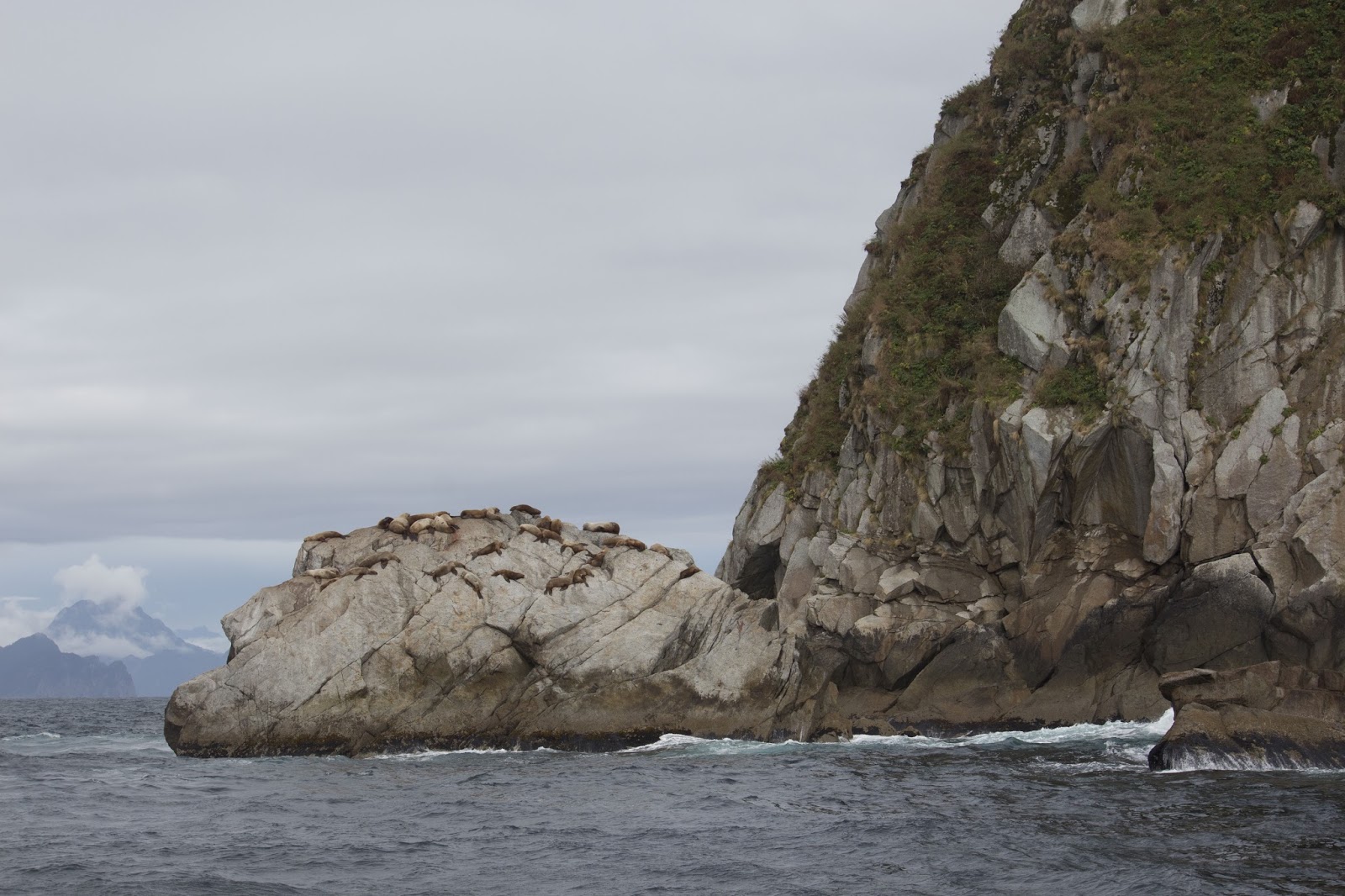
We stopped to view the Steller Sea Lions that had hauled out very high up on the rocks. 

A dramatic resting place
Watching then climb is pretty impressive, too.

Close-up
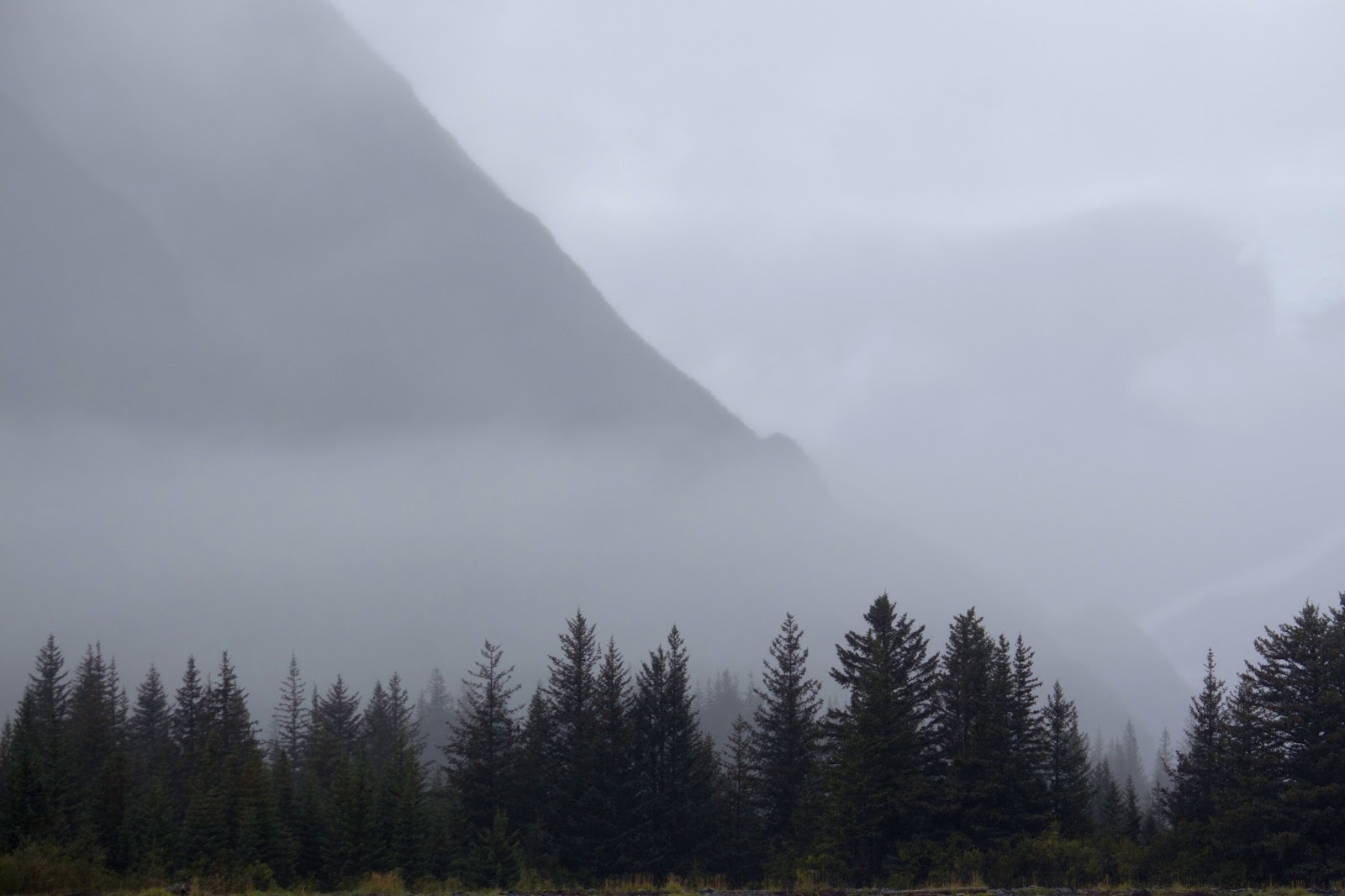
And, even though the weather was rainy ... 

Limited visibility
... we did have some lovely vistas ...

Pretty
And, an exciting run with some Dall's Porpoises.


And extra treat was when we returned to the harbor in Seward, there were Sea Otters right there, eating mussels and posing for photos. 

Cool!
We spent a little time photographing them ...

Enjoying dinner
It was awesome.

The closest I have been to a Sea Otter
When we got back to Alyeska, it cleared enough to make it worth the Alyeska Aerial Tram up 2,300 ft. in elevation and the top of Mt. Alyeska. 

A nice -- but foggy -- view
From the Tram, you can see miles in all directions -- including views of Turnagain Arm, up to seven "hanging" glaciers, the Chugach Mountain range and the resort.

The resort
It was cloudy, but we could see a pretty sunset just around the mountains.

A subtle glow

Trip date: September 10-21, 2015

Thursday, September 24, 2015

September in Alaska -- The Plan and the Trip


Fall is a nice time to visit
Favorable Alaska Airlines fares and a two-year gap from our last Alaska trip prompted Scott to plan a September trip to Alaska.  

Little Susitna River
We had been in late September once before and saw fabulous fall foliage and huge antlers on Moose, so this seemed like a good plan. 

Fall Bull Moose
We entered the Denali Road lottery, but were not selected. I have read that one-in-six wins, but with five entries (Caty and Becca entered for us and I accidentally entered twice, although duplicates are allegedly not permitted), we still came up short.

If you win in the road lottery, you can purchase a single, daylong permit, to drive as much of the Denali Park Road as weather allows. In years with heavy snowfall, the Park Road might be open to Savage River (mile 15) ...

Snow at Savage River
... in milder years, lottery winners are able to drive the entire 92-mile length of the historic road. After the lottery dates, you can often drive out to mile 35, weather permitting. 

Late season Denali
The year we did this drive ourselves, we photographed a Lynx (this is a picture from that trip).

A real treat
We will try again next year.

Still, we planned a trip, with the idea that Scott would fish. I also did some research and found a day trip to Gates of the Arctic National Park. I am trying to visit all National Parks and am down to a few I just haven’t done yet (Isle Royale, Voyageurs, Cayahoga Valley, Dry Tortugas) and some a bit more difficult to reach (U.S. Virgin Islands, American Samoa, Kobuk Valley and Gates of the Arctic). I got the Gates of the Arctic tour on the last day it was offered.

Map: National Park Service
Shortly after we planned everything out, Scott discovered that the fishing season would be over in Copper River (our first planned stop). I checked on the ability to visit the Kennecott Mine at Wrangell-St. Elias National Park, which I had seen but Scott hadn't.

Old mine building
I discovered that the shuttle wasn’t running, increasing the hike to five miles one-way (a bit iffy in fall weather).

So, I rearranged the trip and tried to find a place for Scott to halibut fish and to view Bears on the Kenai Peninsula. I failed at halibut (late in the season), but was able to secure two nights at the Silver Salmon Creek Lodge across the Cook Inlet from Soldotna.

Silver Salmon Creek Grizzly
Of course, aurora was a big objective of the whole trip.

Aurora in Soldotna
So, off we went.

The weather in Alaska this summer had been unusually dry and clear until we arrived. UNTIL is the operative word. We arrived to rain and cold, which stayed with us throughout most of the trip.

We have been extraordinarily lucky to date with Alaska weather (Sunshine in Ketchikan! Seeing Denali for five days in a row! Above freezing temps in February!). We like September because, as the season shuts down, crowds are small. Plus, the bears are big, the moose and caribou have huge antlers and the colors are spectacular. So far, everything had been perfect.

Fall scene
It was time to pay our dues.

We left Colorado Springs on time – a miracle because we usually have some sort of delay when flying to Alaska for a vacation. But, our problems started at the Seattle airport on our layover. We rushed to Anthony’s for our customary crab cocktails to find that they have taken crab off the menu because delivery is unreliable. It’s Seattle! You get crab in Seattle! Whaaaa?!

Besides that, travel was uneventful. We arrived to drizzle and settled in to our hotel. The astronomical outlook for aurora was high; meteorological was low. We got an alert in the evening, but the weather made exploring seem fruitless. It’s too bad we hadn’t opted to drive a bit north and stay in Talkeetna or even further. They had stupendous aurora that night. I pulled this from Spaceweather.com:

Oh well!
The next day, we explored. We started out down the Seward highway, thinking we might go all the way to Seward. And accident on the narrow highway put an end to that. After sitting about 15 minutes, we decided to explore north. Good decision; we read the next day that the accident snarled traffic for three hours.

So, we headed towards Eagle River, where fall was glorious. 

Eagle River area
It was overcast and a bit rainy, but not enough to spoil the scenery. We immediately saw three female Moose along the side of the road.

Alaskan Moose cow
 After looking for Salmon in the river (only a few dead and dying ones, that run was over) ...

Spent Salmon
But, the walk to the overlook was lovely.

Takin' some pix
We headed north and stopped at Reflections Lake, which is right off Highway 1 and is very aptly named. 

The fall foliage was beautiful
We saw animal prints, but no animals.

Raccoon? Otter?
Then, we decided to drive to Hatcher Pass, which is partially paved and partially gravel. We had been there years before on our family trip to Alaska. The scenery, this time cloaked in fall colors, did not disappoint. 

Hatcher Pass
The animal count was low – we saw just a few Hoary Marmots.

Hoary Marmot
Before the gravel part of the road, we stopped at the Little Susitna River Overlook, which was breathtakingly beautiful from multiple angles. This is a perfect spot to appreciate Alaskan fall.


A favorite stop
Then, we drove up through the pass, with incredible vistas everywhere we looked.

A bit foggy, but ...
After the drive, we ended up north of Willow, so we had a nice drive down to Girdwood where we were staying at the Alyeska Resort for two nights. We did a little exploring on the way, stopping to see a few glaciers poking through the clouds ... 

Glacier working its way down the mountain
... and some additional Salmon down near the Portage Glacier.

End of the season fish
We got to Girdwood in time to catch the tidal bore on Turnagain Arm. 
                                               
Map: NOAA
The bore tide is a wave or series of waves that advance down the narrow channel off Cook Inlet, turning the mud flats into a bay again.

The Turnagain bore tide is one of the biggest in the world, actually. All other bore waves run up low-lying rivers in more southerly latitudes. 

The Turnagain Arm bore wave is the only one that occurs in the far north and the only one bordered by mountains, making it the most unique and most geologically dramatic bore tide in the world.

Turnagain Arm tidal bore
We had tried on our previous trip and it was, indeed, a bore. But this time, it was enough for a surfer to catch the wave.


That night, we ate dinner at one of our favorite Alaska spots, the Double Musky. This time we had “just” appetizers – halibut ceviche, jalapeno rolls and scallop-stuffed mushrooms. Delicious! It’s always fun to go to the Double Musky – and we are never hungry enough for dessert.

Happy Scott
So, even though it was rainy, it was a beautiful first day in Alaska.


Kenai Peninsula
Hatcher Pass
Reflections Lake walk

Trip date: September 10-21, 2015